

OAD deposition technique on zinc oxide (ZnO)
Published: 29 April 2026
Michael McKinlay, as part of meLAB, explores oblique angle deposition (OAD) as a viable method for enhancing triboelectricity in a triboelectric nanogenerator (TENG).
Triboelectric nanogenerators (TENG) are a relatively new technology, being discovered only in 2012. It is a device that utilizes two materials of opposing electron affinity to extract charge via friction (whereby one material donates its electrons to another, creating a flow of charge). This allows for its use as a self-powered sensor and energy harvesting device. The goal of this study is to investigate oblique angle deposition (OAD) as a viable method for enhancing triboelectricity in a triboelectric nanogenerator (TENG).
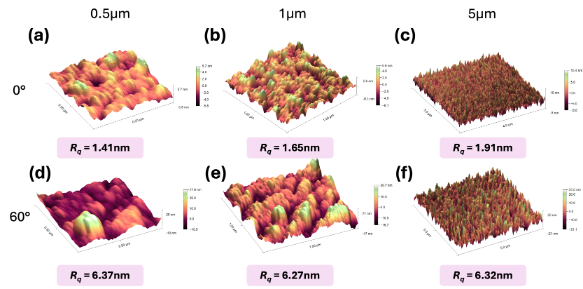
This study investigates the effects of the OAD deposition technique on zinc oxide (ZnO) thin films, a promising material in this field due to its additional contributions to output charge via piezoelectricity and its growth properties. OAD is observed to increase topological effects such as roughness (Figure 1), measured with the JWNC’s Bruker AFM system.
These results were then plotted against each other, where it is found that increasing magnetron power and inclination angle of the sample during deposition, increases roughness drastically (Figure 2).
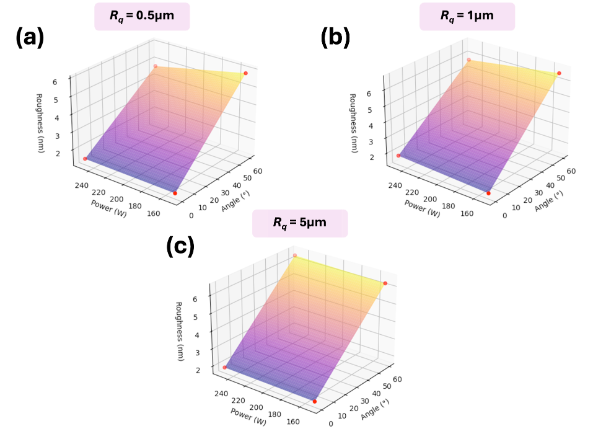
This increase substantially improves the contact area, a core variable that is used to control the output performance of TENG. The values were then compared across all samples (with varying magnetron power and inclination angle) and using preliminary results from the TENG characterization (current, voltage, etc), a pattern between increased roughness and increased TENG performance can be observed, suggesting that topological changes from OAD are a contributing factor to enhanced performance.
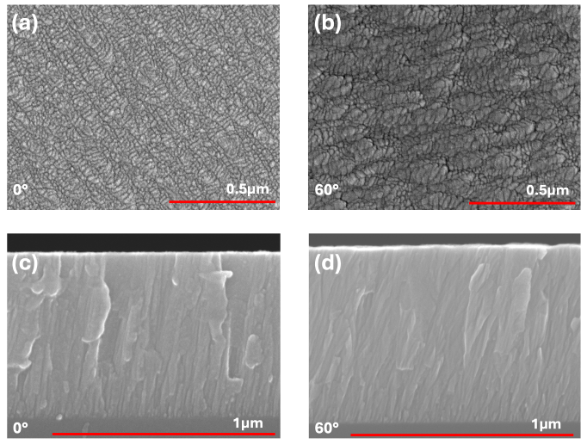
Furthermore, SEM, measured using the JWNC’s Hitachi SU8240, demonstrates an increase in the columnar growth angle (Figure 3) and an increase in particle size, which closely correlates with increased porosity and reduced grain boundaries, thereby enhancing piezoelectricity, as seen in our previous research.
Investigating statistical fittings to the preliminary TENG data, a ~33% increase in charge density can be found when comparing oblique angle ZnO to the standard films. Such improvements advance the fields of autonomous sensors, energy harvesting, and biomedical devices, enabling the development of green, bio-compatible technologies that could operate independently of grid power. Applications also include Internet of Things (IoT) devices and self-charging biomedical implants like pacemakers. These innovations align with the UK’s net-zero goals by replacing traditional energy sources with sustainable alternatives.
This work was conducted by the microelectronics lab (meLAB), based in the University of Glasgow, and is supported by the James Watt Nanofabrication Lab (JWNC).
First published: 29 April 2026