Why the European Charter of Local Self-Government Bill is unlikely to go as far as its advocates hope
Published: 3 March 2026
3 March 2026: As the Scottish Parliament meets today to reconsider the European Charter of Local Self-Government (Incorporation) (Scotland) Bill, Professor Nicola McEwen shares insights from a recent co-authored report, which underlines why the Bill is unlikely to go as far as its advocates hope in protecting local government.
3 March 2026: As the Scottish Parliament meets today to reconsider the European Charter of Local Self-Government (Incorporation) (Scotland) Bill, Professor Nicola McEwen shares insights from a recent co-authored report, which underlines why the Bill is unlikely to go as far as its advocates hope in protecting local government.
Note by Professor Nicola McEwen
The Scottish Parliament is meeting today to reconsider the European Charter of Local Self-Government (Incorporation) (Scotland) Bill. Our report underlines why the Bill is unlikely to go as far as its advocates hope in protecting local government.
The Bill proposes to incorporate the European Charter into Scots law, giving it the same status as domestic laws. The Charter gives legal protection to the principle of local democratic self-government, and to the right and ability of local authorities to regulate and manage ‘a substantial share of public affairs’, as set out in law. Its incorporation is intended to ensure that Acts of the Scottish Parliament and the actions of Scottish ministers are compatible with the Charter. This means that laws and ministerial actions can face legal challenge where they appear incompatible with the Charter.
The Bill would strengthen the status and authority of local government in Scotland. But, following a 2021 ruling in the Supreme Court and the Court’s interpretation of the limits on devolved law making, the Bill only extends legal protections in relation to laws passed by the Scottish Parliament. Much of the law relating to local government predates devolution and so is rooted in Westminster legislation, putting it beyond the scope of the protections offered by the ECLSG bill.
As we set out in our report, the Court’s interpretation of section 28(7) of the Scotland Act has posed new challenges in drafting and implementing key areas of devolved law and restricted its scope. These challenges could be addressed by a minor amendment to the Scotland Act to restore the legislative authority of the Scottish Parliament over the law on devolved matters, regardless of where that law was originally passed. This would be in the spirit of the reset in the relationship between the UK and Scottish Government that followed the 2024 general election.
Read the report
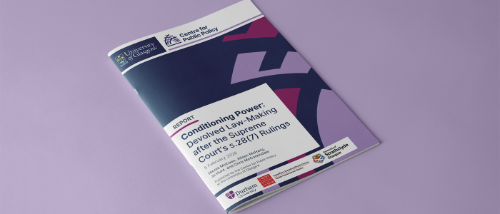
Read the report, Conditioning Power: Devolved Law-Making after the Supreme Court’s s.28(7) Rulings, co-authored by Nicola McEwen (University of Glasgow), Aileen McHarg (Durham University), Jo Hunt (Cardiff University) and Chris McCorkindale (University of Strathclyde.
Read the European Charter of Local Self Government.
First published: 3 March 2026
Read the report
Read the report, Conditioning Power: Devolved Law-Making after the Supreme Court’s s.28(7) Rulings, co-authored by Nicola McEwen (University of Glasgow), Aileen McHarg (Durham University), Jo Hunt (Cardiff University) and Chris McCorkindale (University of Strathclyde.