

SCAF Open Day in Dundee | 20th November 2025
Published: 1 November 2025
Join an engaging afternoon of research talks, a session on interviewing for grant panels, networking, and a tour of the vertical farm at the James Hutton Institute.
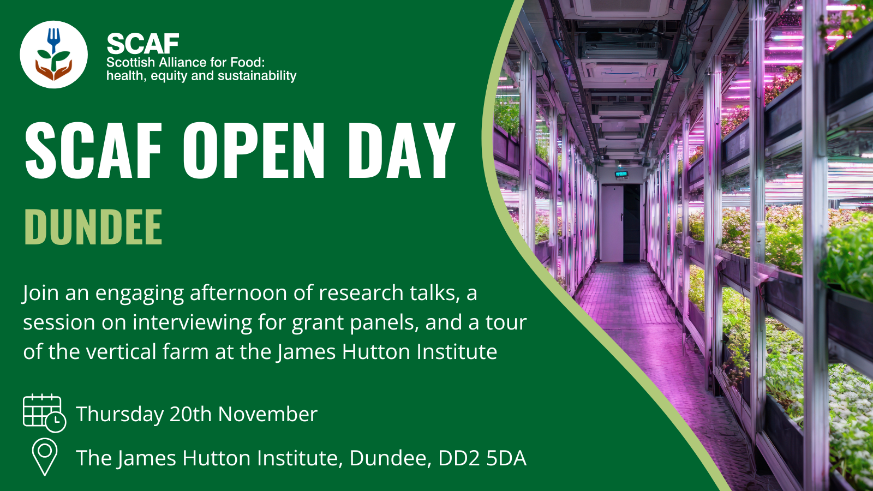
Join an engaging afternoon of research talks (hybrid), a session on interviewing for grant panels, networking, and a tour of the vertical farm at the James Hutton Institute. Plus, meet the SCAF team, find out about SCAF activities and explore the Food Lens Exhibition.
The day is informal and designed to encourage making connections. Drop in and out of sessions as needed; however, we kindly request that you register if you would like to participate in the networking lunch and vertical farm tour.
All are welcome - researchers, practitioners and members of the public!
Programme:
12.00 - 12.30pm - Light networking lunch (please register)
12.30 - 12.40pm - What can SCAF do for you? (hybrid)
12.40 - 13.45pm - Research talks (hybrid)
13.45 - 14.30pm - Interviewing for a grant panel (hybrid)
1.30 - 15.15pm - Seed Dating: a fast-paced networking event hosted by the SCAF Early Career Network
15.15 - 15.45pm - Vertical Farm tour Group 1*
1.45 - 16.20pm - Vertical Farm tour Group 2*
*Times may shift. The guided tour of the vertical farm takes approximately 25 minutes. We can accommodate up to two groups of 15 participants each. Please let us know in the form if you’d like to take part!
Research talks:
Phil Butlin: An introduction to science led vertical farming at IGS
Phil studied for an MSci in Biology at the University of Bristol, where he developed an interest in plant photobiology and how it can be utilised to optimise crop growth in agriculture. This led him to pursue a PhD in plant sciences at the University of Edinburgh, focusing on plant responses to shade. He maintained an interest in controlled environment agriculture during his PhD, spending some time at aeroponics manufacturer LettUs Grow. He followed his studies with an interdisciplinary research position in collaboration with IGS, before moving permanently to become a plant scientist at IGS in 2024.
Intelligent Growth Solutions (IGS) are world-leading manufacturers of vertical farming technology whose systems permit consistent outputs of high-quality produce, year-round and anywhere in the world. Their technology helps reduce the reliance on high-emission food imports while also improving the resilience of local food systems. The desire to continuously innovate has made their total controlled environment agriculture (TCEA) technology both more efficient than market competitors and with a higher capability to permit scientific research. In this talk, Phil will provide an introduction to IGS’s mission, some of the patented engineering technology and how this is being used to push the capabilities of food production in TCEA systems.
Martina Pičmanová: Towards nutritional enhancement in vertically farmed crops
Martina is a plant biochemist at the Advanced Plant Growth Centre at the James Hutton Institute in Dundee, Scotland. Over the last four years she has been involved in various vertical farming projects, focusing on the nutritional analysis of crops grown under experimental conditions. She works closely with vertical farms on the optimized production of nutrient-rich and high-value crops.
Vertical farming is an innovative solution to meet growing food demands and address the global challenges of the 21st century, such as overpopulation, climate change, and the widespread need for healthier diets, as billions worldwide consume inadequate levels of essential nutrients. In vertical farms, crops are cultivated on vertically stacked trays using LED lighting, climate control, and nutrient delivery technologies, all of which can be modulated to optimize growing conditions and enhance the content of key macro- and micronutrients. In this talk I will present several examples of my work with vertical farms on the nutritional enhancement in crops.
Raul Huertas: From Nature to Food Quality and Functionality: Legumes, Alternative Proteins, and Their Possibilities
Dr Raul Huertas is a senior plant scientist with two decades of experience bridging fundamental discovery with practical innovation. His multidisciplinary research explores how crops adapt to the environment and how these processes shape food quality. He develops strategies to overcome environmental limitations and enhance crop traits for resilient, resource-efficient food production. Focusing on legumes and other high-value crops, Raul applies his expertise in pre-breeding, controlled environment agriculture (CEA) and vertical farming (VF) to improve morpho-physiological, agronomic, and nutraceutical traits — leveraging precision farming and biotechnology for sustainable human, feed, and industrial applications. Raul serves as the Science Challenge Leader for Crop Resilience and Sustainability at the JHI and as Future Leaders Champion of the National Alternative Protein Innovation Centre (NAPIC).
Feeding a growing global population under tightening climate and resource constraints requires new approaches to food quality, protein production, and innovation. The National Alternative Protein Innovation Centre (NAPIC) plays a central role in advancing UK alternative proteins as a mainstream and sustainable option. Within NAPIC, the James Hutton Institute leads the Produce pillar, focusing on valorising the natural kingdom to diversify and expand protein sources. Special attention is given to protein-rich crops such as legumes, whose nutritional and functional properties are investigated by testing resilient cultivars in outdoor conditions and optimising controlled-environment setups, alongside the application of modern processing techniques. Together, these approaches support the development of high-quality protein ingredients for future food systems.
First published: 1 November 2025