

More than a game: how sport defines student life
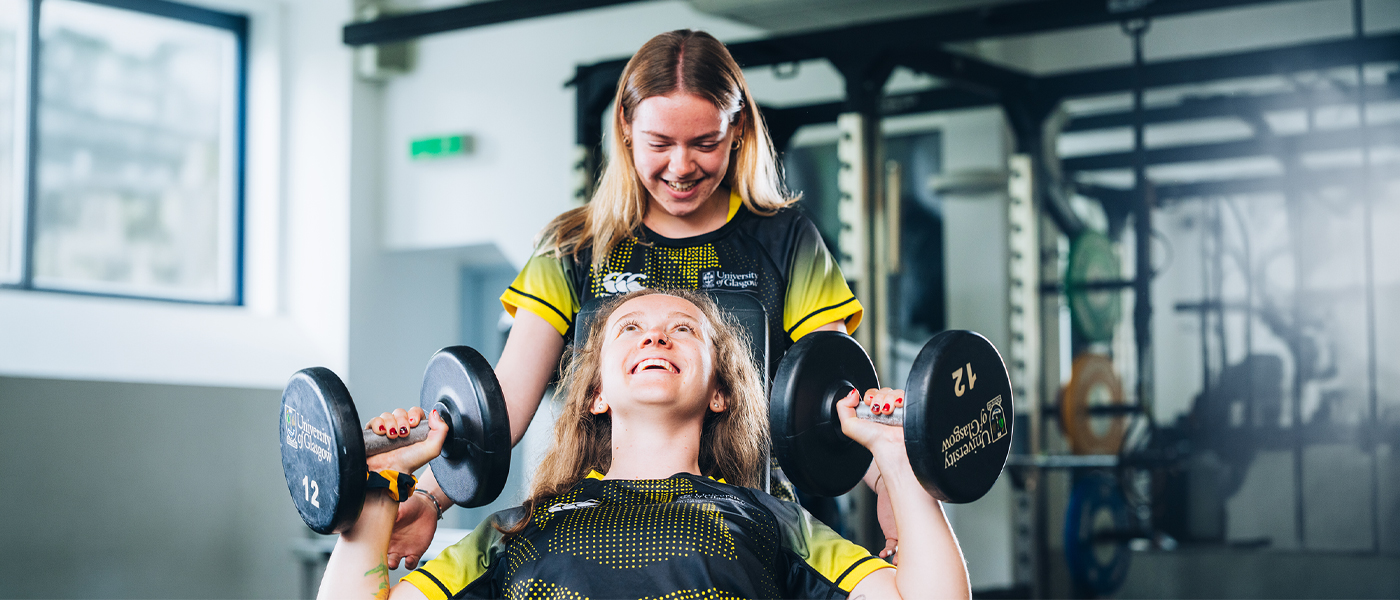
The 2026 Glasgow Commonwealth Games are almost upon us, bringing sport into the spotlight in the city once again. Although the number of sports being contested this year has reduced from the 2014 Glasgow Games, the trend at UofG shows the opposite – student sport continues to grow in popularity.
Research has repeatedly linked participation in sport with improved wellbeing and social connections. At university, sport's association with higher academic performance is even more compelling. The large-scale British Active Students’ Survey (2018) found that students who took part in sport and physical activity reported higher levels of wellbeing and stronger social inclusion than inactive students, and a 2024 study reported student athletes as having better academic performance and an enhanced ability to prioritise and set goals. At UofG, we continue to increase our participation in the BUCS (British Universities & Colleges Sports) sporting leagues, and have reached our highest-ever position in the BUCS rankings tables this year.
Double world champion track cyclist and double Olympic silver medallist Neah Evans (BVMS 2014, MSc 2021, PgDip 2024) is clear about the advantages of taking part in sport at university.
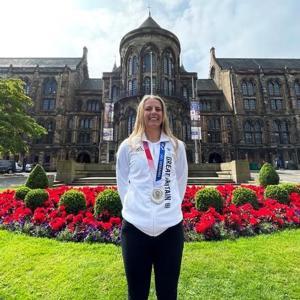 "There’s the health benefits – not just physical, but mental too," she says. "It can be highly stressful being a student, and being able to go out for a run, go to the gym, get that endorphin hit, is crucial.”
Despite Neah’s later successes in the velodrome, she began as a runner at UofG, becoming a dedicated member of the 100-year-old Hares & Hounds club, and says that enduring friendships grew out of her association with it. “Without the running club, I would never have met them, because we were all doing completely different courses. Sport gives so many opportunities to find your niche, your group of people, and it just makes the university experience so much more well rounded.”
For curler Fay Henderson (BSc 2024), who competed at the 2026 Winter Olympics in Milan–Cortina, sport became an essential part of her life beyond the lecture theatre.
 “I think sport gives you another sort of community of people outside of your degree,” she says. “You see the same people nearly every day, mix with the same group. But I think doing any sort of sport – it doesn't need to be elite sport, just something that's good for the mind – takes you away from studying and lets you meet a whole new group of people, which is exactly what uni is about.”
Runner Andrew McGill agrees. The fourth-year student and 1500m specialist credits sport at university as a way to temporarily switch off from his studies.
 "I feel like the two things complement each other pretty well,” he says. “And it’s nice to see people from the University in a non-academic context. After university, I would like to go professional for a couple of years but then get a job after that – I need to keep my mind busy. I run best when I'm doing other stuff as well; it makes you feel less fragile if things go wrong."
UofG Chancellor and Olympic rower Dame Katherine Grainger (MPhil 2001) is passionate about the opportunities afforded by participating in sport at university and regards it as a key part of the student experience.
"I vividly remember the early morning outings on the Clyde down at Glasgow Green and the long days at Strathclyde Park,” she says, recalling her days with the Glasgow University Boat Club, one of the oldest societies of GUSA (Glasgow University Sports Association). "Despite (or maybe because of) the cold and the rain and the exhaustion, university was where I fell in love with what sport gives you – the compelling challenge, the enduring friendships, the growing confidence and invaluable resilience.”
The profound impact of sport at university is undeniable – found not just in podium finishes, trophies and medals, but also in the long-lasting connections forged and memories made.
This feature was first published in June 2026.
My best sporting moment at UofG was ...
“Getting the opportunity to represent my university, club and country at the FISU World University Games in 2025. It was the perfect way to finish my final year, and honestly the experience of a lifetime, with my family and closest friends flying out to support me.” Erin Shaw, taekwondo athlete
“I’m hoping it’s still to come! I would like to have a great run at next year’s BUCS (British Universities & Colleges Sport), with the reward of the World University Games in South Korea if I can place well.” Andrew McGill, runner
"Our BUCS trips to places like Nottingham, Loughborough and Oxford really stand out to me. Competing against English teams has pushed us to a higher level and being able to play a really high standard of university hockey has made these trips so memorable!” Jess Freeland, hockey
“Competing in Glasgow Taxis Cup last year [an annual sporting contest that pitches the three Glasgow universities against each other]. It was great to have so many people supporting – I've never had more adrenaline when playing a tennis match.” Sam Whitton, tennis
“Winning the World Junior Championships in 2023. My team won the Scottish Junior Championships, then went on to the Worlds. I was 21, which is the age limit for the World Junior Championships – that was definitely my best moment.” Fay Henderson, curler
“Joining the athlete programme, where I had a strength and conditioning coach who created a personalised training plan for me. It really helped improve my performance.”
Wei Wei Liu, table tennis
“Winning the Des Gilmore Cup when I was part of the Hares & Hounds. That wasn’t for one standout event, but for consistency in competing over an academic year, so that was special.” Neah Evans, cycling
Images of athletes, left, courtesy of Lewis O'Connor, Team GB and Simon Kerr