

The Research Collection
The artworks located throughout the ARC offer a means to reflect on the vision and mission of the building. Through the collection, we aim to deepen the role that the arts play in our interdisciplinary ethos. Curated by Professor Dominic Paterson, whose selection was guided by the principles of Curiosity, Connection, and Courage, the Research Collection features works by a range of local and internationally recognised artists, bringing together – like the ARC itself – deep Glaswegian roots with a global perspective. Through the purposeful artistic collision of styles and practices, our hope is to inspire building residents and visitors to reflect on the richness of the work that takes place in this unique space.
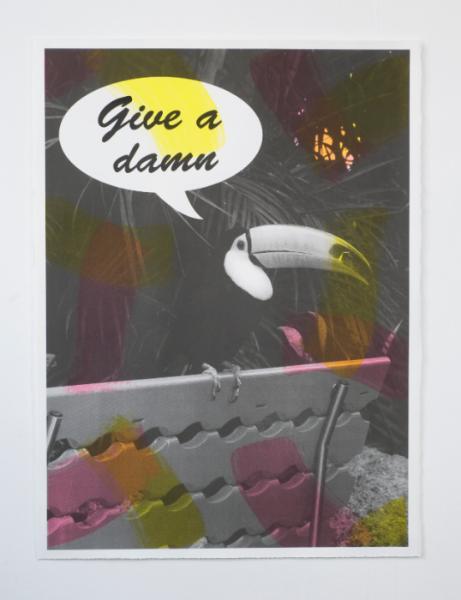 Advice-Giver
Ciara Phillips (b.1976)
2012
Screenprint
Phillips’s work for the Glasgow Women’s Library was made in response to items found in the library’s poster archive. ‘Don’t Call Me Girl!’ by the Chicago Women’s Graphics Collective (c.1975) and ‘It’s Even Worse in Europe’ by the Guerrilla Girls (1989), are referred to in this piece. The Advice-giver, a toucan, tells us to ‘Give a damn’, referring to poster works by one of Phillips’ most admired artists and educators, Corita Kent (1918-86). Through this artistic presentation of a range of sources, Phillips behaves as a collector, storing her references in the artwork itself. Like researchers, collectors, archivists and artists make decisions about what to keep, and what to throw away.
Commissioned by Glasgow Women's Library. Photo: Alan Dimmick
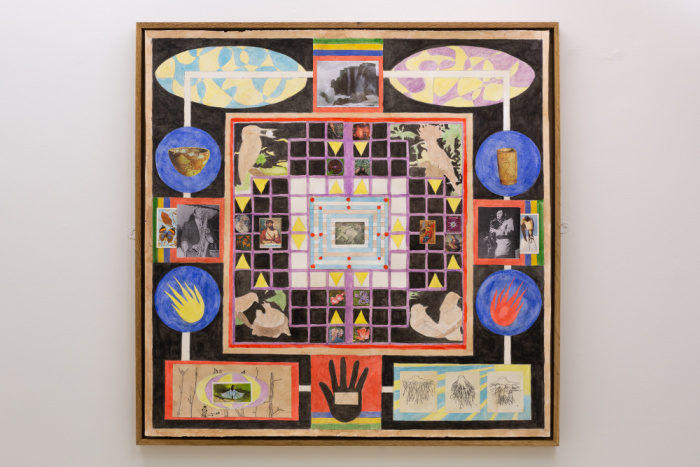 And the running blackberry would adorn the parlours of heaven
Leo Robinson (b.1994)
2021
Watercolour and collage on paper
Leo Robinson is a Glasgow-based artist and musician whose practice employs a combination of illustration, watercolour and collage. This work brings together a range of key aspects from the artist’s practice, such as his use of found material as well as his references to religious imagery and the natural environment. The work’s structure suggests a board game or diagram. The inclusion of found images of jazz musicians relates to the significance of jazz as a diasporic form, as theorised by scholars including Fred Moten and Édouard Glissant. The combination of found images and schematic pathways invites the viewer to move through the work and construct personal narratives. Robinson’s practice, much like the research being conducted across the ARC, is interested in exploration, critiquing perceived foundational narratives and imagining new pathways of interpreting the world around us.
Image courtesy the artist. Artwork photographed by Ollie Harrop for Quench Gallery.
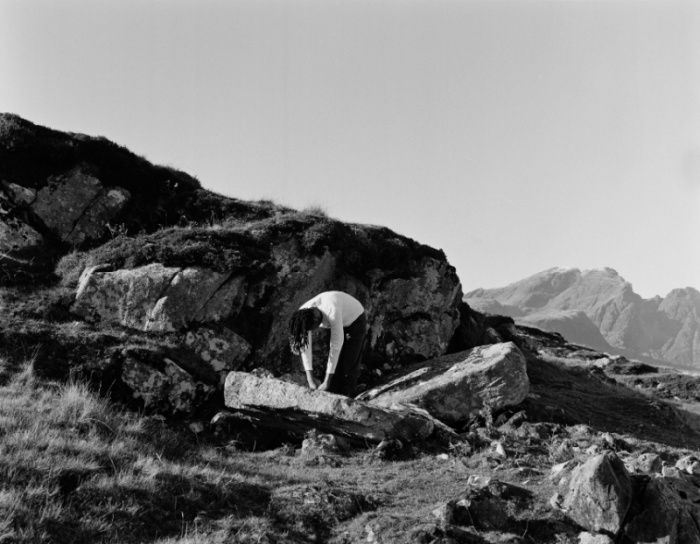 Assuming the Position I
Matthew Arthur Williams (b.1989)
2021
Fibre-based photographic darkroom archival print.
Matthew Arthur Williams is a multi-disciplinary artist based in Glasgow who works with photography, sound and moving image. In these photographic works, the artist draws on personal experiences to explore the position of different communities within Scotland’s rural landscapes. Williams’ work is a sequence and highlights his presence and absence within the landscape to explore issues of land access and ownership. The photographs ask us to interrogate who can belong in the rural environment. This series of photographs was taken by Williams’ on a Bothy Project residency on the Isle of Eigg. A number of Arts and Humanities researchers in the ARC have used Bothy Project residencies to explore and expand their research methods and community engagement strategies.
Fibre-based photographic darkroom archival print. Image courtesy of the artist.
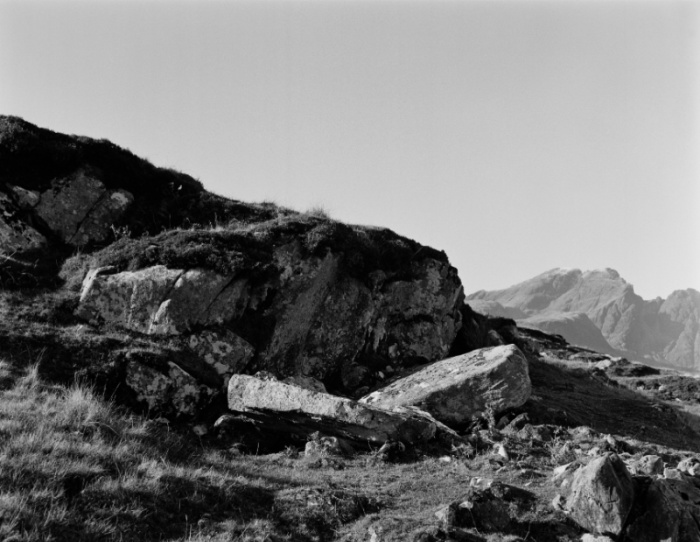 Assuming the Position II
Matthew Arthur Williams (b.1989)
2021
Fibre-based photographic darkroom archival print.
Matthew Arthur Williams is a multi-disciplinary artist based in Glasgow who works with photography, sound and moving image. In these photographic works, the artist draws on personal experiences to explore the position of different communities within Scotland’s rural landscapes. Williams’ work is a sequence and highlights his presence and absence within the landscape to explore issues of land access and ownership. The photographs ask us to interrogate who can belong in the rural environment. This series of photographs was taken by Williams’ on a Bothy Project residency on the Isle of Eigg. A number of Arts and Humanities researchers in the ARC have used Bothy Project residencies to explore and expand their research methods and community engagement strategies.
Fibre-based photographic darkroom archival print. Image courtesy of the artist.
 Formation (Eigg)
Matthew Arthur Williams (b.1989)
2021
Fibre-based photographic darkroom archival print.
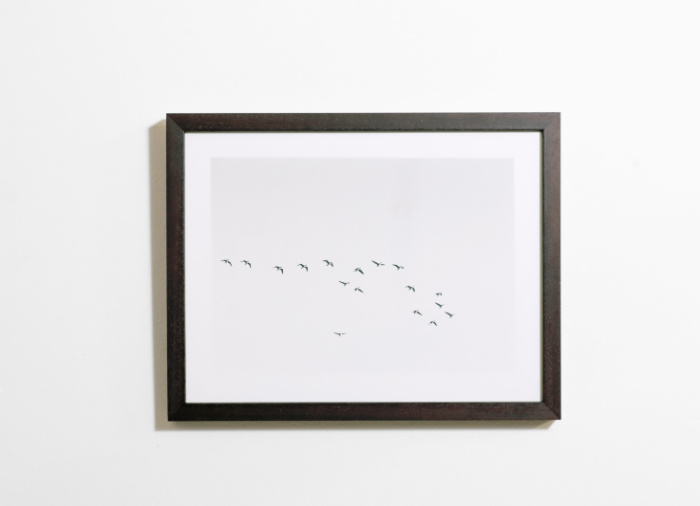
Matthew Arthur Williams is a multi-disciplinary artist based in Glasgow who works with photography, sound and moving image. In these photographic works, the artist draws on personal experiences to explore the position of different communities within Scotland’s rural landscapes. Williams’ work is a sequence and highlights his presence and absence within the landscape to explore issues of land access and ownership. The photographs ask us to interrogate who can belong in the rural environment. This series of photographs was taken by Williams during a Bothy Project Residency on the Isle of Eigg. Several Arts and Humanities researchers in the ARC have used Bothy Project Residencies to explore and expand their research methods and community engagement strategies.
Image courtesy of the artist.
 Black and Blue
Hurvin Anderson (b. 1965)
2023
Screenprint on Somerset white 300gsm
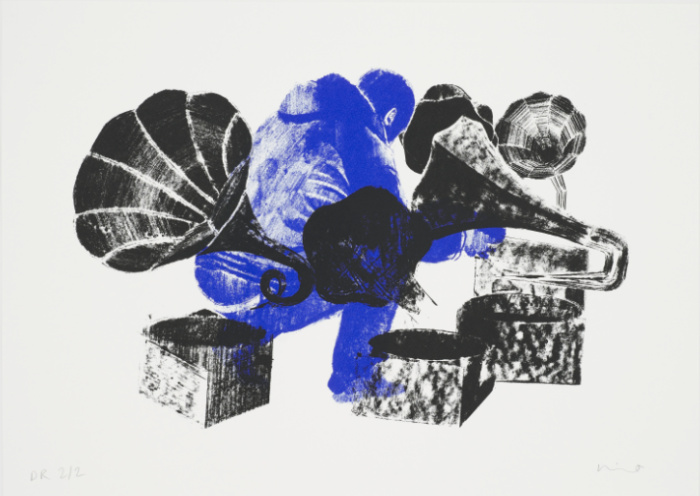
Through intensely colourful landscapes and interiors, Anderson's work moves back and forth across the Atlantic, between the UK and the Caribbean. The youngest of eight children, he was the first to be born in the UK after his family left Jamaica for Birmingham in the 1960s as part of the Windrush generation. His paintings blur the lines between the actual and the imagined. In this print, Black and Blue, a layering effect is employed, creating an uncertain sense of reality. Drawing on the American writer Ralph Ellison’s celebrated novel Invisible Man (1952) as a source inspiration, Anderson also references Louis Armstrong’s performance of (What Did I Do to Be So) Black and Blue. Multiple gramophones play simultaneously; viewing the artwork, it’s almost as if we hear the resulting permeations of the vibrations. With the song itself a well-known protest at racial injustice, Anderson’s subject matter for the work is situated within his ongoing exploration of belonging and diaspora.
 Eldfell Lava Bombs (Collected while still glowing)
Ilana Halperin (b.1973)
2021
Watercolour on Fabriano paper
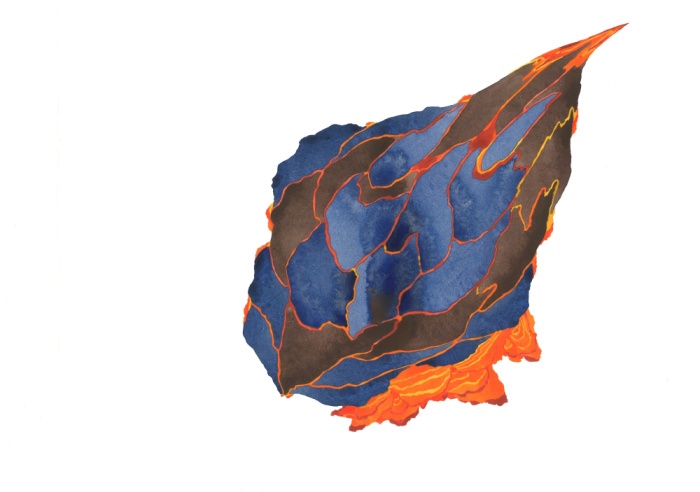
Ilana Halperin is a Glasgow-based artist whose work has often referred to volcanic processes. In 2003 the artist began a practice of celebrating her birthday along with the Eldfell volcano in Iceland which, like her, was born in 1973. Halperin returned to Iceland in 2023 to make an exhibition which included a set of new watercolours, including this one. This series imagines volcanic ‘lava bombs’ in their molten ‘still glowing’ state. Halperin’s work makes points of connection between geological time and the scale of human life and frequently involves collaboration with scientists. The artist’s exhibitions often include scientific material: lava cores; seismograph charts; and rocks collected by volcanologists. Bridging the arts and science, Halperin’s practice represents the spirit of cross-disciplinary enquiry woven into the fabric of the ARC.
Image courtesy of the artist.
 Naming the Money: Kwesi
Lubaina Himid (b. 1954)
2004/2021
Screenprint and inkjet on paper
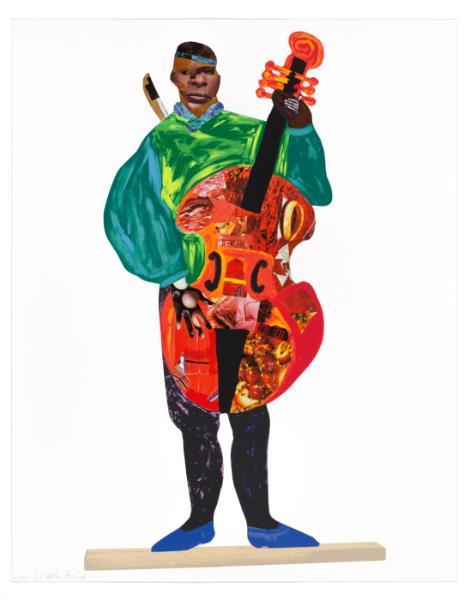
Lubaina Himid CBE is an influential artist, curator and educator who won the Turner Prize in 2017 and will represent Great Britain at the Venice Biennale. Her work focuses on the history of the Black diaspora. This print edition relates to her renowned installation Naming the Money (2004) in which the artist made one hundred life-sized cut-outs, each representing an African slave from the royal courts of 18th-century Europe as depicted in court paintings of the period. Contesting the anonymity in these source pictures, Himid creates a name and a specific, individual identity for each figure. The character of Kwesi is one of several in the group put to work as viola-de-gamba players. Through the presentation of the histories of these previously unknown characters, Himid takes on the role of historian, and the artwork becomes an output of creative research.
Printed by Counter Studio. Image courtesy of CounterEditions.com and Tate.
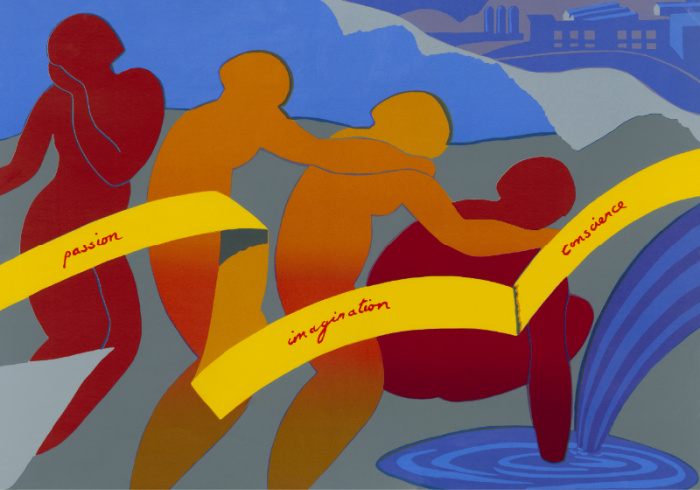 Passion, Imagination, Conscience, Part 1
Sam Ainsley (b. 1950)
1986
Screenprint
Born in North Shields, Sunderland, but based in Glasgow for many years, Sam Ainsley’s artworks interrogate power and politics. Her work centres colour, nature, mapping and the body. Throughout her career, she has considered how art can act as a means to deliver an impactful message. In this series of images, Ainsley pairs her mantra, ‘passion, imagination, conscience,’ with bold feminine forms, depicted in moments of either reflection, connection, or resistance. With colour used as a crucial symbol throughout Ainsley’s work, in this pair of artworks, red and blue are highly significant. In Part 1, the red figures commune and support one another, whereas in Part 2, the blue character is strikingly alone. At the edge of the frame we see the red hand, inviting the solitary blue figure into the community. Throughout her career, Ainsley has represented defiance and collectivity. For Ainsley, these core ideas go hand in hand, recognising that change cannot be driven by individuals alone.
Printed at Edinburgh Printmakers.
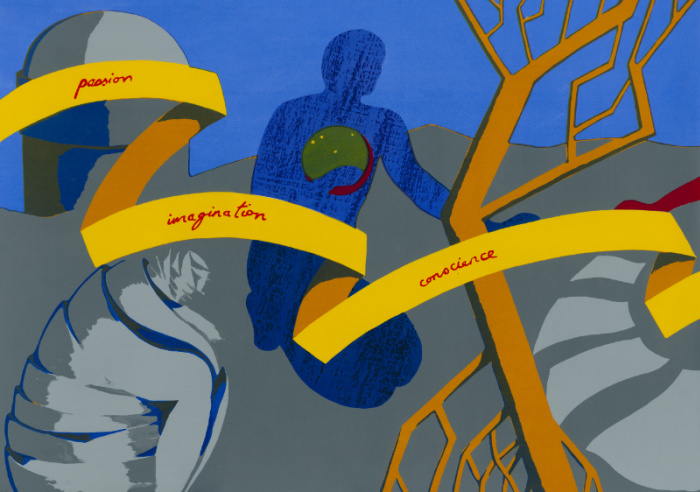 Passion, Imagination, Conscience, Part 2
Sam Ainsley (b. 1950)
1986
Screenprint
Born in North Shields, Sunderland, but based in Glasgow for many years, Sam Ainsley’s artworks interrogate power and politics. Her work centres colour, nature, mapping and the body. Throughout her career, she has considered how art can act as a means to deliver an impactful message. In this series of images, Ainsley pairs her mantra, ‘passion, imagination, conscience,’ with bold feminine forms, depicted in moments of either reflection, connection, or resistance. With colour used as a crucial symbol throughout Ainsley’s work, in this pair of artworks, red and blue are highly significant. In Part 1, the red figures commune and support one another, whereas in Part 2, the blue character is strikingly alone. At the edge of the frame we see the red hand, inviting the solitary blue figure into the community. Throughout her career, Ainsley has represented defiance and collectivity. For Ainsley, these core ideas go hand in hand, recognising that change cannot be driven by individuals alone.
Printed at Edinburgh Printmakers.
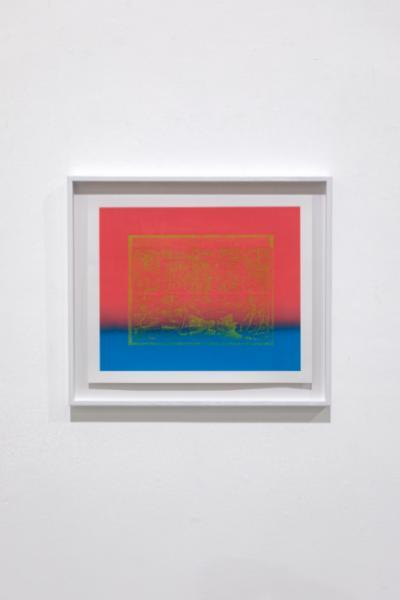 Power From Below: Decolonial Agents
Alberta Whittle (b. 1980)
2021
Laser-engraved woodblock relief print on screen-printed pape
This is one of several works in which Glasgow-based artist Alberta Whittle has reworked 16th-century colonial prints by Theodor de Bry. In this case, she created printing blocks from wood that had been exposed to shipworms - bivalve molluscs that bore into wood immersed in seawater. The artist casts this seemingly insignificant marine organism as a subversive figure in history. Whittle imagines the shipworm as a ‘decolonial agent’ working quietly against European imperialism by consuming the wooden structures of ships deployed in the colonisation of the Caribbean. Whittle’s use of shipworms was informed by a collaboration with researchers, reflecting the ARC’s aim of fostering the co-creation of ideas across disciplines and the decolonial methodologies used by certain researchers inside the ARC.
Image courtesy of the Artist and the Modern Institute / Toby Webster Ltd., Glasgow. Artwork photograhed by Patrick Jameson.
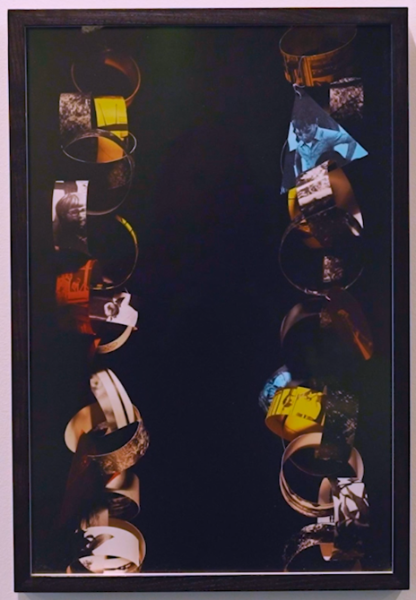 Reaching Up, Around and Through
Corin Sworn (b.1976)
2012
Photographic Print
Born in Canada and based in Glasgow, Corin Sworn is recognised for her thoughtful installations, drawings and films, in which she examines the intimate relationships between humans and objects. In 2013, Sworn represented Scotland at the Venice Biennale. Sworn works as Professor of Arts at the University of Northumbria, regularly publishing academic texts and curating public research exhibitions. Here, a paper chain made from snippets of photographs floats above a dark background. The primary colours and faces of children evoke feelings of nostalgia. Triangles and circles emerge attached to the chain like charms on a bracelet. The subjects are anonymous, and the loops are cut off at the edge of the artwork, suggesting that the chain expands beyond what we can see. We might imagine adding more links and charms to this chain, contributing snapshots of the places and faces personal to us.
Image courtesy of the artist.
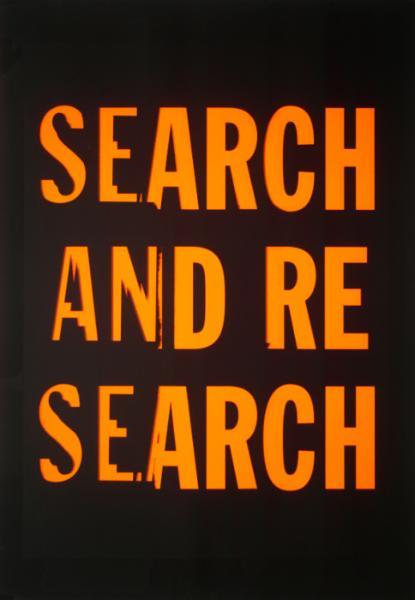 Search & Research
Scott Myles (b.1975)
2011
Screenprint
Scott Myles works with multiple artistic media, moving between sculpture, drawing, photography and performance art. This print amplifies its own visual and textual message as we are invited to question our own definitions of ‘research’. Myles chooses to break the line up visually - search | and re | search – and the word ‘search’ frames and repeats itself. Presented apart from the full word, we are reminded of the prefix ‘re’, meaning ‘again’, and research is presented not as passive, but instead as the action of continued searching. In this artwork, the image and text coalesce, showcasing the possibilities of interdisciplinary working. The print, with a physical form that lends itself to being reproduced again and again, echoes the investigation and discovery that takes place inside the ARC.
Image courtesy of Glasgow Print Studio.
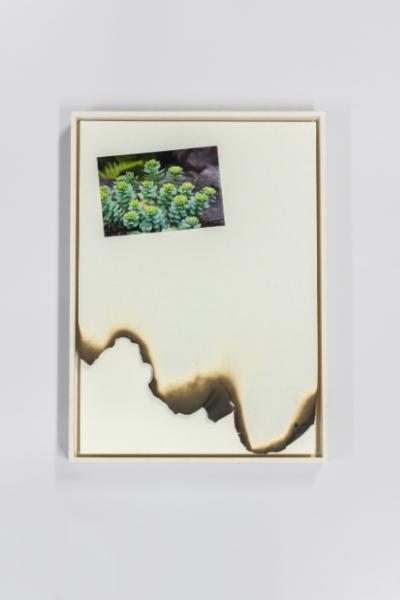 Rhodiola Rosea
P. Staff (b. 1987)
2017
C-type print on scented paper
Interdisciplinary artist P.Staff makes films, installations and works of performance art. In their varied body of work, Staff pays close attention to labour, queer identity and dissent. Rhodiola Rosea is a perennial flowering plant found in Europe and America. Traditionally used as a medicine to cope with cold climates and to reduce stress, it has also been found to increase oestrogen levels. Combining c-print (a photographic print made from a colour negative or slide), with burnt Rhodiola Rosea scented paper, the work suggests a continued process of material transformation, and a mingling of forms.
Courtesy of Artists’ Collective Gallery Ltd.
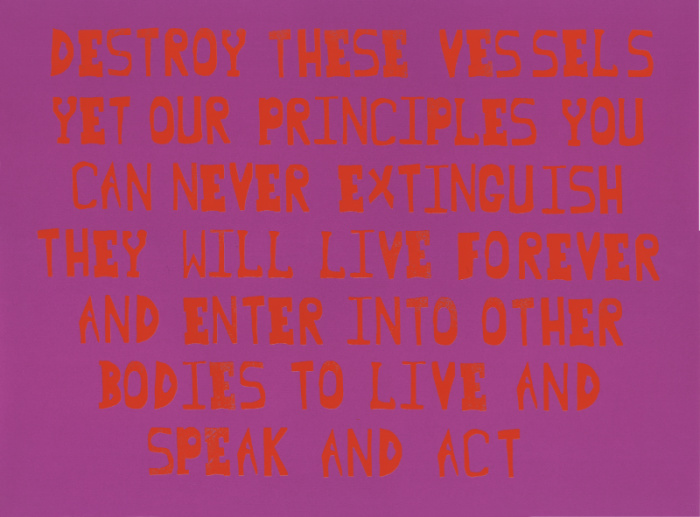 Principles (Edward & Christopher)
Ruth Ewan (b. 1980)
2012
Blocktype and Screenprint
Ruth Ewan is an artist based in Glasgow. Throughout her many artistic forms - events, public works, performance, writing, large scale installations and print – Ewan addresses themes such as power, repression, time and rebellion. Ruth regularly engages in co-production practices, creating artwork with, not simply about, her collaborators. Through her socially-engaged work, she acts as an historian, collecting objects to inform the final piece. Ewan works with institutional archives but has stated that she is more often interested in fringe items, as opposed to official, meticulously catalogued, records. This artwork looks like a political poster, its words a manifesto. Her non-hierarchical message may be heeded by researchers engaging in participatory projects, inviting an ethical and inclusive approach to working with partners. You can view another of Ewan’s artworks, Silent Agitator, in St Mungo Square.
Printed at Edinburgh Printmakers.
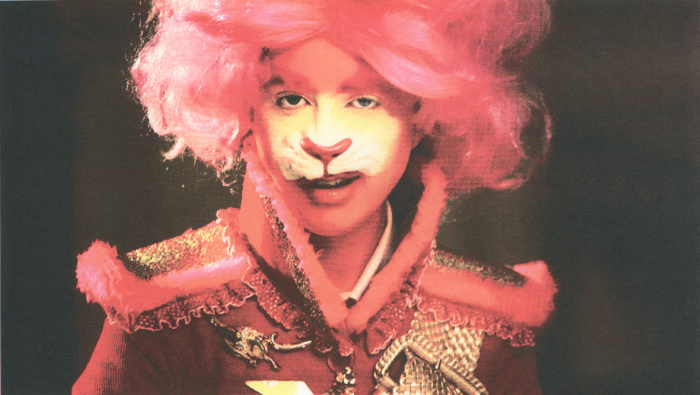 The Lion
Rachel Maclean (b.1987)
2018
Screenprint on Somerset satin 300gsm
As a multimedia artist, Rachel McLean's work is often made and set in the digital realm, taking the form of print and moving image, in which she performs a diverse array of real and imagined characters. Maclean notes, ‘I make satirical art that comments on the troubling and absurd nature of contemporary existence.[...]my work can appear saccharine and inviting, however this belies a darker, more unsettling interior.’ The Lion is taken from a still from Maclean’s film The Lion and the Unicorn, an artwork created ahead of the Scottish Independence referendum. Through posing as the smirking lion, England, the artist presents a national symbol in a setting of political conflict, making use of grotesque, nationalistic tropes to satirise sovereignty.
Printed at Edinburgh Printmakers.
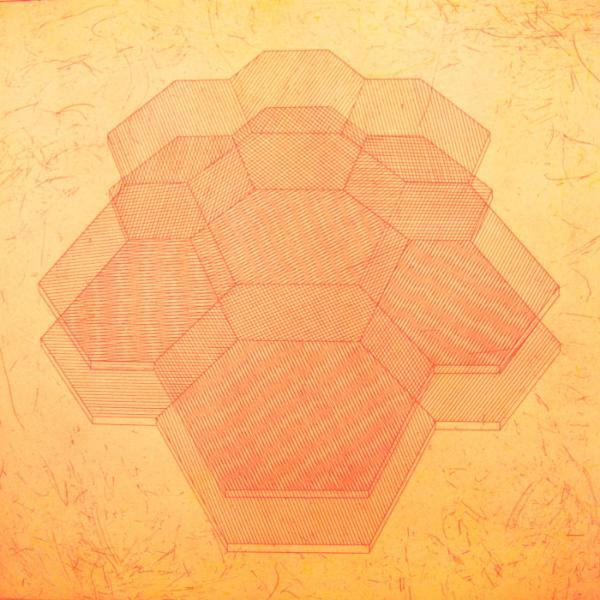 Biocrystals
Rachel Duckhouse (b.1975)
2017
Etching
Rachel Duckhouse grew up in Nuneaton before studying at art school and then moving to Glasgow, where she now lives and works. Her drawing practice explores structure and patterns within landscapes and the fluid relationships between themes such as architecture, water, light and memory. She has worked on several public art commissions, including the entrance gates to the newly redeveloped Edinburgh Printmakers. Regularly focusing on research-based projects, her work often begins with sketchbook drawing and culminates in process-led experiments in the print workshop. She explores connections between worlds through imagined geometries, patterns and places. This etching was based on research into the nano structure of oyster shells and was created during an artist residency at The University of Glasgow’s School of Geography and Earth Sciences.
Image courtesy of the artist.
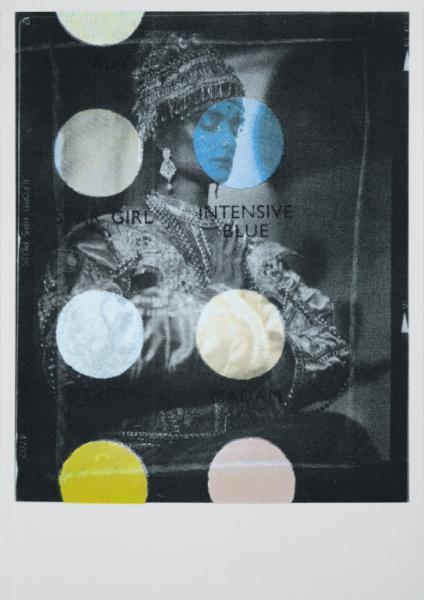 The Silver Maiden (Leichner Palette)
Michelle Williams Gamaker (b.1979)
2023
Screenprint on white Somerset satin 300gsm
Michelle Williams Gamaker is a Sri-Lankan British moving image artist. Since 2014, she has been developing what she terms ‘Fictional Activism’: the restoration of marginalised film stars of colour as central figures, who return in her works to challenge the injustices to which they have been historically consigned. At the centre of this work is the character of The Silver Maiden (played by Ananya Jaidev) from Michelle Williams Gamaker’s new film Thieves, a fantasy adventure retelling of The Thief of Bagdad. This screenprint is a collage of a photograph of The Silver Maiden, with overlays of a 1930s Leichner brand make-up palette. Leichner makeup became a global brand through its endorsement by actress and founder of the Motion Picture Academy, Mary Pickford, who played the Japanese character Madame Butterfly in the 1915 film. In the 1940 Technicolour version of The Thief of Bagdad, The Silver Maiden was played by Mary Morris, a white actress. Across 20th-century cinema, many white actors utilised make-up, prosthetics and costumes to imitate people from other cultures. Through retellings and recastings in her contemporary artwork, Williams Gamaker sheds light on these offensive acts, now largely confined to history.
Artwork photographed by Helen Macdonald.
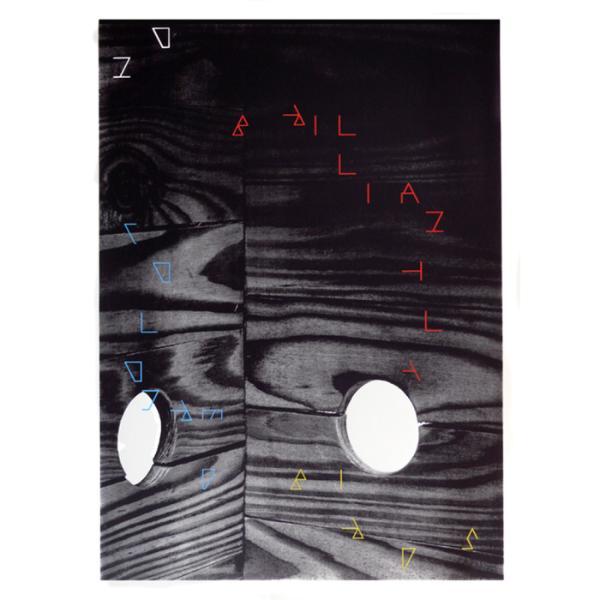 No Brilliantly Coloured Birds
Martin Boyce (b.1967)
2009
Screenprint on paper
Turner-Prize-winning Martin Boyce was born in Hamilton and studied environmental art at The Glasgow School of Art. Boyce is known for his sculptural installations which create urban landscapes in the gallery, often mimicking natural forms. He has described the experience of viewing his installations as like being frozen in time inside a photograph. The stylized letters in this artwork, No Brilliantly Coloured Birds, are derived from a black-and-white photograph of four geometric concrete trees sculpted by Joel and Jan Martel in 1925, a key reference for the artist. During the development of this project Boyce drew from a short text he had written with an abandoned zoo in mind: ‘warm dry stone and palm leaves, no elephants, no giraffes, no penguins’. This language of desertion is continued with the text on the surface of the artwork: ‘no brilliantly coloured birds’. The text tumbles out across an image of an empty wooden interior of a bird box sculpture. This form, which was part of Boyce’s 2009 presentation at the Venice Biennale, was also derived from the Martels’ concrete trees. Interiors and exteriors, nature and architecture, are brought together in Boyce’s art.
Image courtesy of Dundee Contemporary Arts.
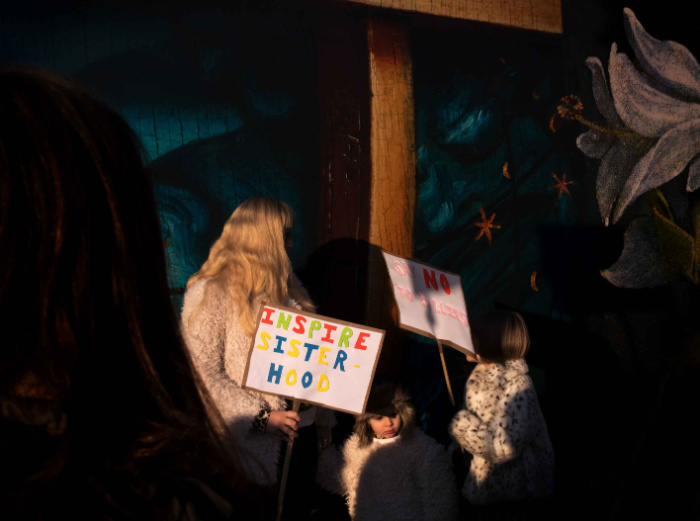 Inspire Sisterhood
Hannah Starkey (b.1971)
2017
C-type photographic print
Born in Belfast, Hannah Starkey studied photography at Edinburgh Napier University and at the Royal College of Art. Starkey is known for creating staged photographs of constructed scenes, observed from the perspective of women. Inspire Sisterhood was taken at the 2017 Women’s March in London. Around this time, Starkey’s work took a decisive turn towards addressing political movements and representations of women’s activism. Inspired by protest marches taking place around the world, the artist began to photograph women as they took to the streets. Diverging from her usual practice of choreographing her photographs, here Starkey captures the real-time activity and language of communities that form through collective action. Rather than capturing the bustle of the huge crowds, Starkey offers moments of stoic solidarity as placards and banners speak the truths of the women holding them. Her photographic work sits between documentary and fiction, positioning the norm as something created, and an expectation projected onto women by an external force.
Commissioned by Hepworth Wakefield.
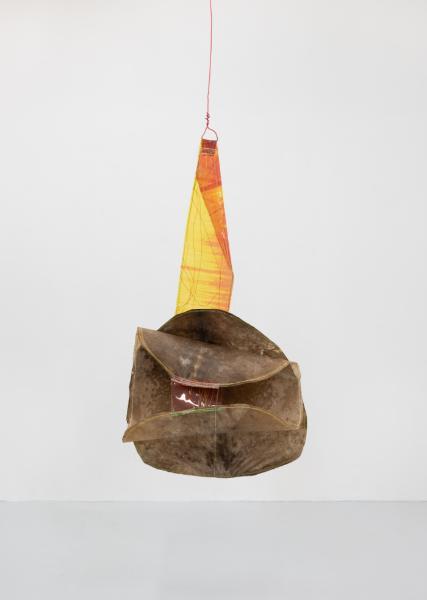 The Possessed of Pigalle or the Tragedy of King Christophe: (Asòtò) "Hugonin [singing] Damballah, he plant his corn yes, he plant his corn mosquito bite him to the blood — this nation not so good, this nation not so good."
Julien Cruezet (b.1986)
2023
Mixed media sculpture
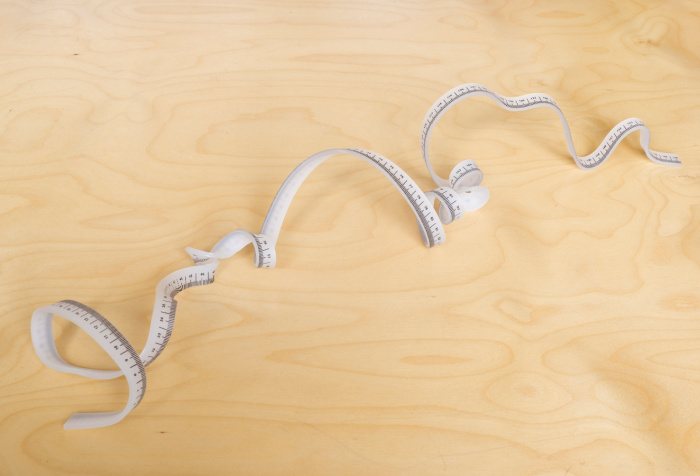 Measure
Rachel Adams (b.1985)
2018
Screenprint on laser-cut acrylic
Rachel Adams is a visual artist who lives and works in Glasgow. She works as a lecturer in the Sculpture and Environmental Art department at The Glasgow School of Art. Adams is interested in creative, domestic and administrative labour, and the systems that are required for the natural and the manmade to interact. Adams’ work explores the relationship between science fiction, sculptural forms and decorative craft techniques, questioning the historical and cultural value of particular materials. Here, a screen-printed sculpture, made with the aid of a laser-cutter, appears as a representation of an easily recognisable piece of sewing tape. The tape, usually pliable, becomes a static, sculptural object, drawing attention to the changing nature of materials and the processes involved in acts of making.
Image courtesy Rachel Adams and David Dale Gallery, Glasgow. Commissioned by David Dale Gallery, Glasgow. Artwork photographed by Max Slaven.
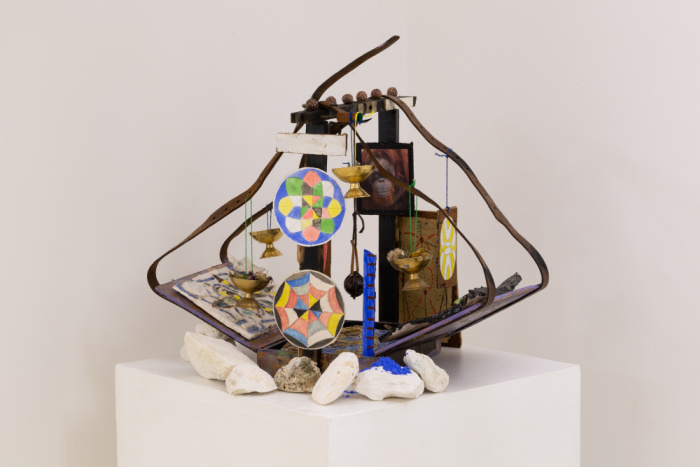 Untitled (Oracle 1)
Leo Robinson (b.1994)
2021
Mixed media sculpture
Leo Robinson is a London-based artist and musician whose practice employs a combination of illustration, watercolour and collage. This sculpture is made up of a range of found materials. The artist describes the artwork as 'a kind of oracle or mystical game’ that includes symbols representing ‘psychological states and the routes between them’. A swinging pendulum guides the user’s interaction with the diagrams. Robinson’s practice as an artist and musician is based on speculative world-building that imagines new systems of knowledge, one which moves away from the effects of colonialism. He believes these new systems have a healing capacity. Works such as this one resonate with the Martinican poet-philosopher Édouard Glissant’s ideas of a ‘new sacred’ that may emerge from post-diasporic cultures.
Image courtesy the artist. Artwork photographed by Ollie Harrop for Quench Gallery.