

Keep in touch
The Spring School has finished, but you can still keep in touch! Below is a list of links from this year's session. Have a browse and get in touch if you want to reach out to anyone, but are having trouble finding contact details.
Tuesday 26 May
Grace Franklin & Joyce Smith
The International Welcome Club
Solo Way Ukrainian Choir
On Facebook
On Instagram
Dilara Özel & Erdem Avşar
Dilara's research profile
Dilara's LinkedIn
Erdem's staff profile
Erdem's LinkedIn
Radia Mohammed Al Madhagi
Together Reaching Higher Wellbeing Hub
Sonia Michalewicz & Romano Lav
Romano Lav homepage
Manar Al-Houbi and family
LinkedIn
Sihui Wang, Gaston Bacquet, Marta Moskal
GLACIER network page
Domingo De Guzman Clemente Cruz
LinkedIn
Rachel Morley
Her staff page
Victoria Touzel and Carlotta Filius
Victoria's LinkedIn
Carlotta's LinkedIn
Alison Phipps & Tawona Ganyamatopé Sitholé
Folding a River
Antonella Sorace
University of Edinburgh staff profile
Bilingualism Matters
Wednesday 27 May
Larry Bottinick
LinkedIn
Peilin Shi
LinkedIn
Aisha Abbas
LinkedIn
Mariia Miskova & Nataliia Spyrydonova
Mission of Innocents LinkedIn
Christina Kyriakidou & CWIN
Central & West Integration Network homepage
Deborah Olivier & Hyab Yohannes
Hyab's staff profile
Hyab's own website
Deborah's LinkedIn
Sih-Ying (Iris) Hsieh
LinkedIn
Agathe Galina Johanna Leroy & Elizabeth Mungai
Agathe's LinkedIn
Elizbeth's LinkedIn
Gizem Karaköse
LinkedIn
Samira Hasanzade & Narmin Alieva
Samira's LinkedIn
Narmin's LinkedIn
Esa Aldegheri
Esa's staff profile
Sawsan Al-Areeqe
Sawsan's UNESCO RIELA Affiliate Artist profile
Coinneach MacLean
Travels in Another Country
An-T-Eilean
Thursday 28 May
Leena Nammari
Leena's homepage
Pinar Aksu & Jane Catlin
Jane's staff profile
Pinar's staff profile
Ali Huntley
Research in Practice
Raneem Knaj
LinkedIn
Ray di Marco Campbell
Staff profile
Glasgow Autonomous Space
Eli Vardzhiyska
LinkedIn
Azadeh Fatehrad
Staff profile at Teesside University
Mirna Šolić, Marzanna Antoniak & Ali Zaregol
Mirna's staff profile
Marzanna's LinkedIn
ArtsLab on Migration and Displacement
Hope Wang
Hope's profile
Paria Goodarzi
Paria's homepage
Exhibitions and stalls
Misa Kanno-Watson
LinkedIn
Sally Zacharias & Dobrochna Futro
Idioms Across Cultures
Andrea B. Reyes García & María Guadalupe Reyes García
COFEMESSS network in Mexico
The National Library of Scotland's Moving Image Archive
Homepage
Nerea Bello Sagarzazu & Ane López
Nerea's UNESCO RIELA Affiliate Artist profile
Anna Lenchovska
Tolerspace LinkedIn
Robin Taudevin
Homepage
Tickets & programme are out!
Good news: tickets for our 9th annual UNESCO RIELA Spring School: The Arts of Integrating are now available to book through this link!
This year's programme was developed in collaboration with the Institute for Collective Place Leadership at Teesside University and was supported by the National Library of Scotland's Moving Image Archive and Multilingual Matters.
The Full programme for the Spring School 2026 can be downloaded here or you can read it as an online flipbook here.
Keynote speakers:
* Prof Alison Phipps (University of Glasgow)
* Larry Bottinick (UNHCR)
* Coinneach Maclean (independent tour guide)
* Antonella Sorace (Bilingualism Matters & University of Edinburgh)
* Grace Franklin & Joyce Smith (International Welcome Club)
* Leena Nammari (independent artist & University of Dundee)
Keynote listeners:
* Holly Trundle
* Sawsan Al-Areeqe
* Paria Goodarzi
Exhibitions & stalls:
* Women's Collectives in the Social and Solidarity Economy for the Sustainability of Life in México - by Andrea B. Reyes & María Guadalupe Reyes García (COFEMESSS)
* 折り紙 Origami – collective act of folding for caring and sharing - by Misa Kanno-Watson (independent)
* Bigger than I: solidarity and help in dark times - by Anna Lenchovska (Tolerspace)
* Eskaintza (Offering) - Nerea Bello Sagarzazu & Ane López (independent artists)
* “My babcia always used to say...” Sharing intergenerational idioms - by Sally Zacharias & Dobrochna Futro (both University of Glasgow)
* Sharing is Caring: Co-constructing Inclusive, Creative, and Love Community Across ‘Difference’ in Glasgow’s Southside - by Ray Di Marco Campbell & colleagues (Glasgow Autonomous Space)
* Care Engine - by Erdem Avşar (University of Glasgow)
* What We Carry Together - by Paria Goodarzi (independent artist)
* Showcase of archival films - by The National Library of Scotland’s Moving Image & Sound Archive
* Momentary and Fleeting: A Life Documenting Conflict and All That It Displaces - Exhibition of the photojournalism of Robin Taudevin (14.03.1977 - 14.05.2006) curated by Julia Taudevin
Sessions on 26 May:
* Songs as Living Archives - by Solo Way Ukrainian Choir
* The Story of the Traveling Plate: Returning What We Receive - by Dilara Özel (independent researcher) and Erdem Avşar (University of Glasgow)
* Caring Through Creation: Intergenerational Transmission Across Glasgow - by Radia Mohammed Al Madhagi (Together Reaching Higher CIC)
* Amaro Kheliben (Our Dance) - by Sonia Michalewicz (Romano Lav)
* My Story, Our Future: story connections as acts of care - by Bria Angelle Trosclair (University of Glasgow), Helena Fox, John Weeks, Louna, Mena, Salma & Edith (all ESOL Scotland)
* Learning from Practice: Community Practitioners' Insights for Social Prescribing Training - by Victoria Touzel & Carlotta Filius (both Bielefeld University)
* Caring without inheritance: an ethnographic reflection on unaccompanied migrant youth in Catalonia - by Domingo Clemente Cruz (Blanquerna - Universitat Ramon Llull)
* The Power of Three Ms: From Gaza to Glasgow - A family Story of Sharing and Caring - by Manar Al-Houbi (University of Glasgow), Mohammed Alshaikh (independent researcher) & Mira
* Educational Justice Across Borders: Care, Equity and Humanisation in Global contexts - by Marta Moskal, Gaston Bacquet & Sihui Wang (GLACIER network, all University of Glasgow)
* Cloth of gratitude - by Rachel Morley (University of Glasgow)
* Folding a River by Heart - Tawona Sitholé & Alison Phipps (both University of Glasgow)
Sessions on 27 May:
* Hakka Women’s Stories, and Meeting Glasgow’s Elderly Anarchists - A storytelling duo performance followed by artist talks and discussion - by Peilin Shi, Josey-Ann Green & Boya Li (independent artists)
* Jagged Roots- How elders and communities carry culture forward - by Aisha Abbas (independent researcher)
* Caring Hands, Living Heritage: Ukrainian Intergenerational Art Practices in a Scottish Context - Mariia Miskova & Nataliia Spyrydonova (Mission of Innocents)
* What We Carry: Memory and Intergenerational Exchange - by Christina Kyriakidou, Hadia Mohammadi, Lina Fernanda Rangel, Luz Dary Rodríguez, Mohammad Hamami, Tahereh Samori, Diana Pimiento Castro, Isabella Solano, Taylor Del Castillo & Peilin Shi (The Central and West Integration (CWIN) Art Group)
* The ‘work’ of passing on - by Deborah Olivier (Julius-Maximilians-Universität Würzburg) & Hyab Yohannes (University of Glasgow)
* Zines of Care: Crafting Intergenerational Literacies - by Sih Ying (Iris) Hsieh (University of Glasgow)
* Carelaborations of Spring Schools past and present - by Sarah Stewart (Friends of Scottish Settlers)
* Weaving a sens of belonging - by Agathe Galina Johanna Leroy (University of Glasgow)
* No More Bad News – Strikes Back! - by Erdem Avşar & Bella Hoogeveen (both University of Glasgow)
* Care, Language, and the Space Between Us - by Gizem Karaköse (Nicolaus Copernicus University)
* “Əldən ələ” — From Hospitality to Trust - by Samira Hassanzade & Narmin Aliyeva (both University of Glasgow)
* Mai arrendersi, never give up: when stories become pathways of resistance - by Esa Aldegheri (University of Glasgow)
Sessions on 28 May:
* How can social care services be reimagined to develop intergenerational approaches to support older adults? An Appreciative Inquiry Approach - by Ali Huntley (Research in Practice)
* When Displaced Voices Speak: Listening, Language, and the Meaning of Care in Multilingual Societies - by Raneem Knaj (University of Glasgow)
* Embodied Experience of Memories and Languages through Plants - by Pinar Aksu (University of Glasgow) & Jane Catlin (University of Strathclyde)
* Sharing is Caring: Co-constructing Inclusive, Creative, and Love Community Across ‘Difference’ - by Ray di Marco Campbell (Glasgow Autonomous Space)
* Weight for light to inherit an Icon - Towards a synaesthe-tic Formation - by René Landspersky (independent artist)
* A not-so-simple origin story: Tracing a melody across borders, bureaucracy and (post)migrant bodies in Berlin - by Eli Vardzhiyska (Freie Universität & Humboldt Universität Berlin)
* Listening to Language: Care, Silence and Untranslatability - by Azadeh Fatehrad (Teesside University) & Hyab Yohannes (University of Glasgow)
* Grounding, Guidance and Giggles (creating an ancestral atlas of care) - by Mirna Šolić (University of Glasgow), Marzanna Antoniak & Ali Zaregol (independent artists)
* The Lyrical Tradition: Cultural homeland, nostalgic writing, and poetical dwelling - by 汪筱薔 Hsiao-Chiang (Hope) Wang & Tawona Ganyamatopé Sitholé (both University of Glasgow)
Call now closed
The call for contributions is now closed and the programme is being developed following a rigorous selection process by a selection committee of 10 people from different backgrounds. We expect the programme to be ready and tickets to become available in early April.
If you would like to be notified when that happens, please head to our front page and subscribe to our mailing list (at the bottom of the page).
Spring School 2026 Call for Contributions
The call for proposals for our 9th annual UNESCO RIELA Spring School: The Arts of Integrating is out!
Download the SS26 call
Deadline for application: 2 February 2026
The UNESCO Chair hosted within the School of Education at the University of Glasgow undertakes a programme of work focused on multilingual knowledge exchange in the area of refugee and humanitarian protection, with a focus on fostering multilingual, multimodal and multilateral models of integration through creative and cultural expressions. We are now inviting community groups, artists, academics, students, third sector organisations and anyone working on community building to respond to this call for contributions to our next UNESCO RIELA Spring School 2026.
Theme: caring and sharing
The Spring School is a 3-day in person knowledge exchange event, organised and hosted by the UNESCO Chair on Refugee Integration through Education, Languages, and Arts (UNESCO RIELA). We host this annual event in person in May, with an online edition during the Southern Hemisphere Spring. At our 9th annual Spring School in 2026, we will explore intergenerational caring and the sharing of knowledge, wisdom and practices in the context of (forced) migration and restorative integration through education, languages and the arts.
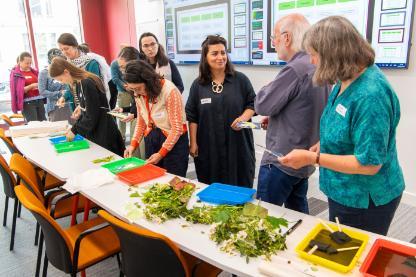
How can Elders, the living archives among us, pass on their language, history, culture and wisdom to younger and future generations when spatial, temporal and political barriers stand in the way? How is care organised when people are forced to flee? Who carries culture forward, and how is it kept alive when communities are broken up and dispersed? Can cultural heritage be maintained and transmitted within new communities, and what mechanisms or efforts are involved? How can destination countries support those experiencing the loss of cultural and linguistic heritage? How do refugees and people seeking asylum access knowledge about their own cultural heritage? UNESCO has declared a Decade of Indigenous Languages and the wisdom-speech, linguistic inheritance and forms of speech of elders, and of those beginning steps in the languages of home are critical to intergenerational forms of care for intangible cultural heritage. How are the generations undertaking care for culture and language in times of genocide, pain and protest?
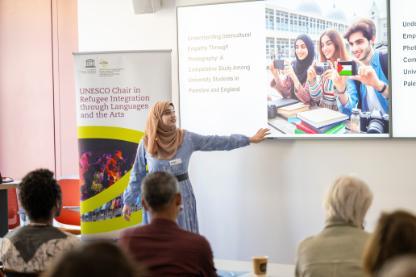
We want to understand how intercultural caring and sharing is organised, how it can be supported by longstanding communities and what we can learn from these practices. We welcome proposals that offer practical examples, as well as performances and academic reflections. We are particularly keen to hear from migrants and people seeking refuge, and we favour interactive and creative formats over formal presentations.
We invite creative contributions that connect with the theme and with UNESCO RIELA’s thematic areas to apply. We are looking for proposals for workshops, performances, presentations, discussion panels, and other creative ways of sharing and generating knowledge.
Key information:
When: 26-28 May 2026
Where: Glasgow, Scotland
For whom: creatives, academics, students, community groups, policy makers, third sector organisations and anyone else with an interest in community building
Deadline for application: 2 February 2026
Contact: Bella Hoogeveen (Project Manager) at unesco-riela@glasgow.ac.uk
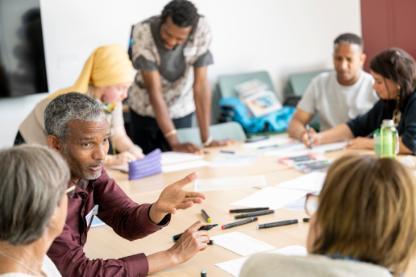
Submission Process
- Written description of maximum one side A4 (11pt Calibri)
- Link to an audio/video recording of maximum 2 minutes
Please include:
- Title of your contribution
- A description of your contribution and its aims
- Format and duration of your contribution
- Name(s) and short biographie(s) of the presenter(s) - around 100 words per person
- A explanation of how your contribution links to the theme
- Any audio-visual, IT, space, access, language or other requirements you might have
- Any days/times you CANNOT present on 26, 27 and 28 May 2026
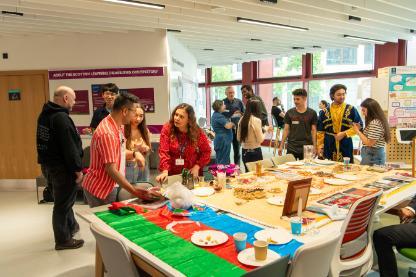
Next steps
Proposals will be assessed by a mixed panel, made up of members of the wider UNESCO RIELA family, based on the following criteria:
- Fit with the theme of intergenerational caring and sharing
- Fit with UNESCO RIELA thematic areas (education, languages, arts)
- Originality, we hope to learn from new stories, initiatives or methodologies
You will be notified of the outcome by Friday 27 February 2026. If your proposal gets selected, you will be requested to send us a promotional text and at least one image for in the programme booklet. We will request this is returned by Monday 9 March 2026.
The Spring School runs on a very tight budget – this is how we can ensure it remains FREE to all with no registration fees. Unfortunately it also means we cannot pay presenter fees.
Due to the location of the event, it will not be possible to provide on-site childcare. If you will require childcare, please get in touch with us as soon as possible to see if we can assist or partially subsidise childcare as required.
For examples of programmes from previous years, please see our website. If you would like to discuss your proposal before submission, please contact Bella Hoogeveen at unesco-riela@glasgow.ac.uk.
We look forward to receiving your proposal!
The UNESCO RIELA team
Alison Phipps, Hyab Yohannes, Tawona Sitholé, Esa Aldegheri, Pinar Aksu and Bella Hoogeveen
Click here to download the SS26 call