Minimising Airborne Infections in NHS Surgical Theatres via Real-time Flow Simulation and Virtual Reality Visualisation
Published: 8 June 2026
Airborne contamination is a major contributor to surgical site infections. This work combines real time flow modelling with immersive Virtual Reality (VR) visualisation, to enable surgical staff to see airborne contaminations and therefore minimise infections by exploring new theatre designs and surgical procedures.
Airborne contamination is a major contributor to surgical site infections. Bacteria are commonly transported by airborne particles at surgical sites and can be easily deposited into open wounds or onto sterile instruments, causing catastrophic consequences.
To mitigate airborne contamination, Unidirectional Airflow systems are widely used in current operating theatres. These are designed to continuously sweep contaminants away from critical areas, minimising turbulence/entrainment. However, the presence of equipment and surgical staff significantly disrupts the UDAF flow. These can substantially excite airborne bacteria carrying particles, contributing to still frequent occurrence of airborne surgical site infections.
This project combines real time flow modelling with immersive Virtual Reality(VR) visualisation which enables surgical staff to see airborne contaminations and thereby explore new theatre designs and surgical procedures to minimise infections.
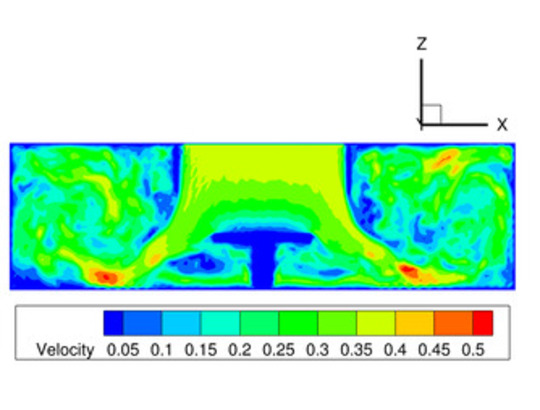
Firstly, the study explores modelling strategies for surgical site flows by adapting a novel GPU-accelerated Lattice Boltzmann flow solver developed in our CFD Lab. This tool offers faster than real time aerodynamic modelling on modern GPUs. The second part links the modelling with immersive visualisation. This leverages the visual system of our Daedalus-I flight simulator, originally developed for high-fidelity pilot training. The work explores the interfacing with existing VR prototypes, establishing a unique toolchain for environmental flow problems. The third part explores how new surgical procedures/room designs can minimise airborne infections.
Contact
T. Zhang - Lecturer, Tao.Zhang@glasgow.ac.uk
C. Nikou -EPSRC Vacation Intern Charikleia.Nikou@glasgow.ac.uk
First published: 8 June 2026