

Research Stories
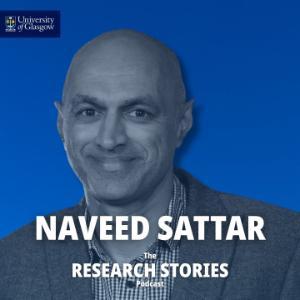
Naveed Sattar: Can We Solve Obesity
Professor Naveed Sattar discusses weight loss drugs, the role of curiosity in scientific discovery, the importance of challenging accepted ideas, and how evidence-based research shapes healthcare policy.
Listen on Apple Podcasts | Listen on Spotify
Drawing on decades of work in diabetes, obesity and cardiovascular disease, Naveed explains how randomised clinical trials transform medical practice, why obesity has become one of the defining public health challenges of our time, and how emerging weight-loss therapies could reshape the future of healthcare.
In this episode:
- The origins of curiosity, scientific thinking and challenging established expertise.
- How research evidence progresses from observation to world-changing clinical practice.
- The importance of randomised controlled trials and why they remain the gold standard of medical evidence.
- Key discoveries linking obesity to diabetes, fatty liver disease, psoriasis and other long-term health conditions.
- The growing obesity crisis, changing food environments and the role of public policy.
- The opportunities and limitations of new GLP-1 and weight-loss medications.
- Working with policymakers, industry and healthcare systems to improve public health outcomes.
- The future of diabetes prevention and treatment research.
- Lessons on leadership, humility, resilience, mentorship and lifelong learning.
Guest Bio
Professor Naveed Sattar is an internationally recognised scientist and Professor of Cardiometabolic Medicine at the University of Glasgow, as well as an Honorary Consultant at Glasgow Royal Infirmary. His research focuses on the causes, prevention and treatment of obesity, type 2 diabetes, and cardiovascular disease. He has authored more than 1,000 scientific publications, contributed to major international clinical guidelines, and played important roles in landmark clinical trials. In 2023, he was appointed Chair of the UK Government Obesity Healthcare Goals Programme.
Partnership Ecosystem
- University of Glasgow
- NHS Scotland
- Glasgow Royal Infirmary
- UK Government Obesity Healthcare Goals Programme
- American Diabetes Association (ADA)
- American Heart Association (AHA)
- Pharmaceutical companies developing obesity and diabetes treatments
- Clinical trial networks across the UK and internationally
- Policymakers and government advisers
- Public health organisations
- Research groups specialising in obesity, diabetes, cardiology and metabolic medicine
Hosted and produced by Nick Bruce, with questions, recording, editing, mixing, artwork and original music by Nick.
Production assistants: Temiloluwa Ajayi & Conor Molloy
Links and resources from this episode
Transcript
NB: So when people ask you what you do, how do you explain it without sounding too complicated?
NS: Yeah, no, that's a really important question. Um, so I'm a doctor who researches into the causes and prevention and treatment of heart disease, diabetes and obesity and their sort of intersection. That's what I do.
NB: Okay. Um, when we spoke before, before we recorded today, we spoke about curiosity. Um, and you are a curious person, obviously that goes without saying. Do you have any sense of where your curiosity comes from?
NS: That's - I don't actually know. I think it partly comes from personality. Some people are just curious, just genetically they're born curious - look at the world and think, how does, you know, something they've seen work or… and actually in medicine, when you're taught medicine, it's didactic. When I did medical school and we were taught probably not to be that curious. And the curiosity only came to me, um, when I was a junior doctor sitting in a boring reporting session when a consultant came along to me, handed me a whole pile of data on the results of fish oils in pregnant women in thousands of women and said, what do you make of this? And that… something woke up in my brain and said, oh, new data - I have to formulate a question. And, you know, you've measured all these things - why did you measure them? What would be the relevant questions? And that, I think, was the kind of moment where I started using my curiosity again. And curiosity actually also comes from partly mathematics, because maths explains everything and maths is actually seeing how the world works, how an atom works or bounces off something, or visualization of a risk pathway and how it causes disease. And I, and I was very good at maths at school, and I thought I'd never do maths again. But actually research allowed me to think about maths, how things connect and visualise connections. And I think that's what I've been doing over time. And the other thing I would say, as I've gained more confidence in research, I've gained more confidence in asking “is so and so who's supposedly a world expert standing on that platform saying something about disease, is that actually correct?” And because it doesn't feel correct from my understanding, and to challenge. Because everything we learn comes from uncertainty and challenging things.
NB: And did you get the confidence to do that with experience and time? Or were you - or was there ever a time when you were intimidated by someone? If someone said, “what do you make of this, Naveed?” Was your first reaction to just to think, “oh, what do I think of this?” Because for a lot of people, their first reaction might be to go, “Somebody asked me a question, what do I say?”
NS: So that's a brilliant question because actually I can compare myself to my wife. My wife hates getting asked questions. She’s really bright, but she's got some kind of genetic makeup that means that she's scared of being asked questions. But I think she's as bright as I am. She's just different. Um, and she went through - and she said this recently, she went through the whole of school scared that the teacher would ask her a question and ducked her head and therefore didn't do as well as she could. And she's, as I say, she's really bright. I've got the opposite phenotype. So I have actually very rarely been scared of anyone asking me a question, because the answer is, if I don't know, I usually say, “well, I don't know the answer. What do you think?” Because actually, none of us knows everything. None of us knows really anything with ever full certainty, and we're all here to learn from each other and challenge each other in a nice, collaborative way to learn more.
NB: I'm interested that you seem to sort of believe that that ability that you have is genetic. Do you? Is that right? Is that accurate to say or do you think that it's just something you've cultivated over time?
NS: It's partly genetic because clearly when you, you know, when you have kids yourself, you can see that they can be quite different, you know, the same parents, the same, you know, some partly genetic, but it's also partly your upbringing. You know, my father was always a curious individual and maybe that helped me. (I) was a product of environment and genes. That's what it is. And also partly luck. You know, you fall in with the right people. You see - you get the right mentors, and you see how they interact, how they make new waves in research by being curious and how they are not scared to perhaps, you know, say what they think, but also be willing to be wrong sometimes. So it's luck to be born with the right genes, have the right upbringing, going into the right mentors, and the accumulation of all of that leads to where you are. I think it's luck. That sounds a bit immodest, but I think it is partly that.
NB: Do you think that institutions like ours, like the university, do enough to encourage curiosity, or is it something that researchers like yourself have to protect and cultivate for themselves?
NS: Oh, that's another really good question. I think when I went through medical school, the answer was no. However, when younger, more contemporary medical students, I think they you know, certainly let's talk about medicine because that's what I know most about. They are, I think, given more opportunities to be curious and ask questions. Because things have changed a little bit in the way we teach. You know, it's not just didactic lectures. It's tutorials, it's asking questions, it's evaluating data, it's coming back with hypotheses. So increasingly we do ask students to be a bit more curious. We haven't necessarily given them the self-efficacy, though to explain exactly how that works. So the ideal scenario would be, I think for me, would be if I could, and I'm just thinking about this on the hop, would be to give them an example of when I was really curious. It embarrassed me but actually led me something better. And that's happened. I'll give you an example, I went to a meeting with the head of the American Heart Association and American Diabetes Association who are world leaders in medicine, and they were going to devise new criteria for risk score. It was in London, very high-powered meeting, and I stood up and I said, I'm not convinced that you need to revise this because I don't really think the way that we're doing this risk score is necessarily right. And I was told in front of all these people to shut up and sit down, literally. And that's my recollection. I sat down and I was really embarrassed, but I knew that we had data that we were going to submit that confirmed my impression. And the very next morning I thought, right, I'll show you so and so's. I phoned the Lancet and said, “would you like this paper? This is what it shows, and this is why it's important.” Long story short, we actually got that published three months later in The Lancet. It's been cited several hundred times, and it helped get rid of that as a risk score for clinical practice. There you go.
NB: But there's an inherent vulnerability in curiosity, right?
NS: Yes.
NB: Do you think that that is something that perhaps researchers, maybe earlier career researchers need to get more comfortable with? With being vulnerable enough in those types of situations or in group situations, collaborative situations, to acknowledge that they don't know everything.
NS: Exactly. How do we do this? The other thing, I think that's helped me, and again, it's partly luck, is that in the speciality that I grew up in, it's called, you know, chemical pathology or metabolic medicine - we are looking at blood parameters that relate to many disease or many organ systems, kidney function, liver function, blood cholesterol, endocrine system, you know, we do all of that. And then I did also, I did clinics in quite a lot of those things. And then I got to look at data in terms of how people look at big data sets called epidemiology. In fact I had a call this morning from LBC radio about a paper that came out a few days ago - I'll maybe come back to that. So then I got used to looking at data and understanding the strengths and weaknesses of data. So I got good at epidemiology, I got good at biomarkers, and then I started to look at a lot of diseases. And then I got involved in mechanisms, and then in trials and then guidelines. So I've had that fantastic, rich experience of lots of different specialties and how to interrogate those specialties from big data sets, from what the mechanisms may be, from what trials show, and for how we place all that into guidelines. And that privilege has allowed me to make connections between disease areas, perhaps well before other people have. So we were the first group in the world to show, for example, and this might surprise you, that obesity is a cause, partly a cause of psoriasis. And amongst the first people to show that gain in liver fat was a cause of diabetes. And now we know that type two diabetes, which is a very common condition, is actually a disease largely of excess ectopic fat. And if you lose the weight early on, as Mike Lean and colleagues have shown, and I helped a little bit with that, with the direct trial, which has been world changing, is that an early diagnosis of diabetes, if you help people lose fifteen kilograms, the diabetes more or less goes away, which has changed practice around the world. So little things that I've learned, you know, we've published in small ways have helped make a bigger paradigm, which then helped lead to trials that change practice.
NB: And thinking about - you're making these important discoveries, but we're living in a world of, you know, complex competing narratives, social media hot takes, big, bold claims in the media, especially now that we've got fat loss drugs and things like that. But how do you help people to understand what solid evidence actually looks like?
NS: So that's exactly as I said, let's come back to the call I had this morning. There was a paper that came out in the British Journal of Ophthalmology that said one of the drugs for weight loss, it causes an eye condition, which is a bit like having a stroke in the blood supply to the nerve of the eye. And they said it's a five-fold risk, but it was epidemiology. So I had to explain to them, well, if you look at the totality (of) evidence and put it into context, we're not yet sure that actually, if there is a risk, it's going to be one in ten thousand. So very small. But look at the whole benefits. You have to put it into context. So that comes with integrity is to know the evidence base from the randomised trials against placebo, because that's how we get to the truth - randomisation. There was a paper published by my colleagues in Oxford and they were correct. The beauty of randomisation helps you get to the truth of what a drug does. So wherever you can do randomised trials against placebo, that's how you get to the truth. Epidemiology can never always get to the truth, or it can take a long time unless there's a clear effect. So for example, it took us twenty years or so to work at the smoking, or people to believe that smoking causes heart disease because no one did a randomised trial. But obviously it was clear cut. You know, it was - smokers got more cancer. Those who stopped got less cancer. Those who smoked more cigarettes got more cancer. So it's accumulation of epidemiology that led us to that. And then we did the big public health intervention, the smoking cessation - the second place in the world that did it was Scotland. Smoking rates went down. And guess what? Heart attack rates in Scotland went down the next year.
NB: Can you just clarify what a randomised trial is and how it differentiates?
NS: So a randomised trial would be if we take a group of individuals and randomise them to get the active drug or a matching placebo which has not got any active drugs - it's just a placebo. So you take ten thousand individuals, and you want to know if drug X is going to lower the risk of heart attacks. And what you do is you make an active form of the drug X, and you make a placebo (that) looks exactly the same. And then at the point that you recruit the individual; you randomise them by a computer code so over the ten thousand, if you look at the two groups that got the drug, they're identical in terms age, blood pressure, social class. And no one knows who got the drug. I don't know who got the active drug because the computer holds the key. No one knows. The doctors don't know. We treat the people we give them (the drug or placebo) for five years, and then we break the code. In fact, we've just published a study called Vesalius in thirteen thousand patients. An injection for lowering cholesterol versus a dummy injection. The Vesalius drug, which is a drug that lowers cholesterol, lowered cholesterol by, you know, a decent amount, and it lowered heart attacks and death by about fifteen to twenty percent. Clear cut. No evidence of adverse side effects. And the only time we knew who took what is when we unblind them at the very end, when the trial's finished. What we do then, we take the code, say, okay, these are the people, the five thousand who got the drug, these are the five thousand (who) didn't and if you look at the number of heart attacks and strokes, we add them all up – oh wow, there's about a twenty percent lower risk of people who got the active drug, had heart attacks or died. That's why we do it.
NB: And then what? Then what happens?
NS: And then then that drug, if the benefits look substantially greater than any potential harms - in this case, the harms were virtually trivial, that then advances the case for that drug to be indicated as a treatment to lower cholesterol, to prevent disease. That's how statins came in. The first randomised trial to show that statins, which are the main drugs which lower cholesterol, that protect against heart disease and stroke, was published from Glasgow. It was called the WOSCOPS trial (West of Scotland Coronary Prevention Study). We took six thousand five hundred and ninety-five men in the west of Scotland, and half of them who smoked. All of them had high cholesterol. We randomised them to a dummy tablet or Pravastatin. And my colleague Jim Shepherd, showed that it actually reduced the risk of heart attacks by about thirty percent. Fantastic. And then after that, statins became indicated as a treatment for lowering cholesterol. Cardiologists got on board. We started to treat more. And now if you look at the UK, around about several million people are on statins. Randomised trials.
NB: Okay. I just want to ask you about your work with government organisations and things like that. You've worked a lot with government organisations. You now serve as the UK Government's Obesity Commission Chair. So how does your work and your role operate differently when your audience is policymakers and government officials?
NS: I find that challenging, um, only because I'm used to writing papers, and we get the result, and we publish it, and then we move on. So policymakers, obviously there's a whole cadre of rules and regulations and it takes time. You know, it's a bit like treacle, it takes time to make convincing cases. I'm not sure I've done that role tremendously successfully, but I do know the evidence and one of the things that I've managed is to convey that evidence to people who are in positions of power. And I've also helped basically provide a little bit of glue between people, for example, the pharmaceutical industry, to tell them what we have in UK that would make it more attractive for them to place confidence in putting their trials into the UK. That brings money and investment into the UK. It also gets our doctors to use these drugs sooner, and it also means that there are some diseases where we get the results faster if we can do them in the UK for faster benefit for the UK environment. So my job is primarily education. Know the evidence, convey that evidence. Also coalesce other scientific experts in the field to say where are the gaps that we're missing in the evidence we need to advance the care of people with these drugs. What are the trials we need to do? What are the systems we need to put in place? What are we missing in the UK to make us more attractive for outside companies to come into the UK to place their expensive assets and their money to do more trials within the UK? I'm not sure that I have done it brilliantly, but having said all of that, the biggest limiting factor for us using more drugs in the NHS for weight loss is actually the cost of the drugs, which I can't influence. Even the governments can't influence. That's dependent on what the companies wish to charge. And then it's also then governed by external forces, like what changes that the American president wishes to enforce on drug companies and their pricing of drugs, which has changed lots of drug costs. So, for example, the commonest drug we use now for weight loss in the UK is called Mounjaro, or Tirzepatide is its proper name. Its cost was, you know, it was about, I don't know, £150 a month. But suddenly after the president of the US said, actually the costs have to be equalised, they were about eight times more expensive in the US. And the president said, well, actually, I don't want that, I want them to be equal. So then the UK cost went up! So anyway, so I'm doing my best. I've been doing it for two years. I think I've learned the process a bit better. And now, in the same way with research, I'm developing a stronger energy to challenge. You know, it's taken me two years because if you don't know what you're talking about, you're not going to challenge. So as I've learned stuff and seen how things can be improved, I'm starting to challenge funders, for example. Why aren't we funding more in the obesity space? Why aren't we all thinking alike to do more trials? Um, but that's again, it's difficult because people don't like to be told that actually from someone who perhaps is outside of their system, that they should be doing stuff. But the evidence base - let me step back. The evidence base now, and I have had calls and discussions recently with obstetricians, respiratory doctors, anaesthetics, gastroenterologists, cardiologists, heart failure experts, dermatologists, rheumatologists - they're all facing a tsunami of obesity. And if you go into our wards in the Royal Infirmary, it’s full of people between 50 to 90, whose obesity levels are much higher than they ever were. And because they are living with obesity for many more years, they're all living with, five or six conditions, three or four of which are linked to obesity.
NB: Do you a sense of why that is?
NS: Two things. We have done brilliantly in this country, the first country in the world to do primary prevention of statins. We've had some of the best blood pressure experts in the world. We had the ASCOT trail (Anglo-Scandinavian Cardiac Outcomes Trial), which was blood pressure in the UK. So we've reduced heart attacks and strokes substantially. Lots of risk factors have come down, but the one risk factor that's been going in the wrong direction in a sizeable way, guess what? Obesity.
NB: Why?
NS: The environment’s changed. So I'm older than you, actually, Nick. You know. Yeah. No, I'm much older than you, so I'll give you an example. Look at the environment. In 1970, the time of Showaddywaddy. You wouldn't remember them…
NB: Yes.
NS: Yeah. Okay. Uh, and ABBA were in their pomp and, you know, and so on and so on. And the Bay City Rollers. So when I was growing up, the only fast-food outlet was a fish and chip shop. We had one in our town, Blantyre. I grew up in Blantyre in Lanarkshire. The first time I ate in a restaurant (I) was 23. We had one packet of crisps if we were lucky per week. We had one biscuit packet for the whole week for the family because there just wasn't the variety and things. Now look at the world - food everywhere.
NB: Just you've just reminded me there. I grew up in a small town, and I'd never been to a McDonald's before I turned 18. And the first time I went, I asked for a hot dog.
NS: Oh, there you go. Exactly. How would you know? Yes, exactly. And now, look, if you say to the average 18-year-old, have you ever been to McDonald's? Oh, yeah, a thousand times. It’s everywhere. We could just put on our phone and order a Deliveroo, and it comes to you. So the world has changed. And the other thing that's making obesity worse I think is the iPhone.
NB: And so this is where we are. This is the world that we're living in. Obesity is going up. What's the answer? We’ve got weight loss jabs now. Is that the solution? Is it just a distraction? What is the real answer?
NS: It's not a distraction because there are so many people living with obesity that it's too late for them to change environment. And even if we're able to change the environment back to the 1980’s, which isn't going to happen any time soon, if ever, that doesn't then serve the population, (or) many people living with obesity. And I will tell you, a lot of people listening will think, “well, actually, it's all about willpower”. It's not willpower. Ninety percent of it is the environment. People do not want to be living with obesity. And the best evidence for that is the fact that two million people are paying out of their own pockets to buy these drugs. Even we have we have colleagues of mine who are domestics, who have, you know, whose salary might be twenty thousand a year, who are paying £300 a month to buy these drugs. We have people selling their cars to buy these drugs.
NB: And what do you think is the motivation for these people to buy them?
NS: Because unless you've lived with obesity, you don't know how people suffer. So they, you know, they find it harder to be physically active. For some, they develop certain conditions linked to obesity. So diabetes, sleep apnoea, liver disease, you know, the list is endless. I've described it, kidney disease, heart failure, hypertension, abnormal blood lipids, sleep apnoea, psoriasis, and, you know, and on pregnancy complications, you know, stroke, cataracts is linked to psoriasis, gout. Everything to varying extents. So either they're either suffering because their weight is too high and they can't have the same energy and mobility. They have a lot of food noise, and they only think about food. They're not happy with the way they used to look compared to what they look like now. So both in terms of mental health, ability to do stuff and developing diseases, you know, it's not good.
NB: It’s incredibly complex.
NS: It’s complex! And unless you've lived in the shoes of someone with obesity, you do not know what they feel like. But I can guarantee you the evidence is there. People do not want to be living with obesity. We have we can do better at trying to explain and give people a little bit more self-efficacy, arming them with a bit more knowledge and know-how to improve their diets, but that's only going to slow it again, because what's happening is the food environment is seducing more and more people to overeat. So the solution is, yes, lots more of the drugs and the right people at the right time. That in turn might help improve the environment. And on top of that, what we need - and the government knows this - this isn't me speaking heresy - we need to have more legislation to improve the food environment. But then we also need to have the willing part. And the food industry and the drinks industry be willing to make less profit. And that then requires shareholders to accept less profit for the benefits of society.
NB: As soon as you say that, I think, well, that's never going to happen. Am I just being a pessimist?
NS: No. I worry. I worry as well. I worry. reed is a human emotion. We've all become greedy at some points in some parts of our life. But you know, why is it the billionaires want to make even more billions? It must be addictive. So we have to - governments around the world have to enforce more rules to limit corporate profit. You know, I don't want to use the word “greed”, but that's what it is.
NB: We have to call a spade a spade.
NS: Yeah, we have to. We have to do that. And we have to equalize. You know, more and more money's gone to less and less people over time. And that's causing this imbalance. And then (for) half the population, food is much cheaper. People still say there's a cost-of-living crisis. I don't know how we're going to solve this, but to be honest, you can see the vision though, would be legislation, more taxation on companies to help. It's difficult. You know, we don't want companies to go bust. We need companies to make profits, but we don't need them to be so profitable that it's taking money away that could be used in better ways to allow better education for our youngsters to allow better housing and have more jobs.
NB: You're able to be in the room and have these conversations with policymakers about legislation and things like that. Is this message landing?
NS: Uh, no, I'm not at that right level. I mean, I don't sit in front of the First Minister and other people to talk. You know, it's probably at second or third hand. I make a lot of those points in some of the papers I write. I hope some of those papers are then, you know, like all of us, all researchers, we hope we write papers that people read that then eventually have some impact. But I am starting to develop more courage to say those things in multiple forums. Let me step back to the medical part: if we do not treat the obesity that is apparent in someone who may only have one condition now, but it's likely to get four or five conditions if we don't treat the obesity, but only treat that condition, they're going to develop more conditions. It's going to cost more money, more suffering. And that you know, so that's the kind of thing I'm going to say. If we don't start investing more and doing more about legislation and trying to improve the food environment, we're going to have more children perhaps going on these drugs and that's not what we want. Obesity is rising fastest in young people and in women. And that's a problem because young people don't want to give them drugs because, you know, is that a good thing? And women, of course have to have reproduction. And we don't know what the drugs do in terms of pregnancy.
NB: Does the existence of a drug like this almost provide sort of a free pass…?
NS: It's been said before. I was actually thinking about that yesterday as I was speaking to colleagues who are helping create some of the policy around Scottish Government and health and for the NHS, and to try and counter that, I tried to say, well, look, actually the drugs alone at the moment are only limited to people at the very highest risks. We can give people better education about diet and lifestyle. And I'm hoping to develop and I've, you know, I got the nod yesterday to develop a better tool, i.e. a one-page document that we can give in all clinics to help people better improve their diets, so that we can slow weight gain or help stop people putting on weight. So it's a lot more people will not need the drugs in the future. You know, we haven't done that well enough. We can do that better. So you're right, the drug should not be seen as “well, I won't even try now with my diet because I'm going to get the drug in five years”. In reality, in ten years’ time, if we do have more of these drugs available, and the cost comes down to about £50 a month, and we’ve got tablets, and the benefits of those tablets in trials substantially outweigh the harms, I suspect millions more will be using those drugs. But the optimistic hope is if that happens, that because appetites are curtailed, that that in turn helps change the food environment in a positive direction.
NB: So it would be a net positive anyway, even if we got there in a slightly different route.
NS: Exactly. So sort of a back door route as it were. It doesn't matter, you know, and sometimes it doesn't matter how you get to the destination as long as you get to the destination.
NB: What research question are you still burning to answer?
NS: Oh, wow. Um, well, one I've already put out there in a paper is that type-2 diabetes - and you know, in a sense, my colleagues, Mike Lean and, uh, and Roy Taylor and our brilliant Glasgow and Newcastle teams, which I again helped a little bit with in the direct trial, showed that if you can reverse weight by about ten, fifteen kilograms, you can reverse diabetes or undergo remission. So the paper I wrote with a colleague called John Buse, who’s a fantastic Doctor in America, who's also the Head of the ADA, American Diabetes guidelines. He and I wrote a paper saying that actually, in five to ten years’ time, we will be at the point of diagnosis of diabetes and maybe even prediabetes, the process of care will be giving a GLP-1 in one of these new drugs to help people lose 15, 20 kilograms and get rid of the diabetes for another 10 years. I'd like for us to do those trials to prove that. And the important thing about diabetes - diabetes is defined in sugar, but actually the risk doesn't just come from the sugar. The risk is there 10 to 15 years in advance. It's the obesity. The obesity causes the high sugar, the high sugar further accelerates risk but if you solve the obesity, you get the sugar down, you also improve the blood pressure, improve the blood lipids, you improve how much volume and caloric stress that your liver, your pancreas, your blood vessels, your filters, like your kidney are suffering. So that's what we'd like to do.
NB: And that's a popular misconception, isn't it, that if you eat too much sugar…
NS: Yeah. No, it's about weight. You could eat no sugar but still be overweight and get diabetes. So what happens is if you put too much excess fat in your liver, the liver continues to make sugar in excess of the body's needs because it doesn't respond. Your liver can make insulin, glucose, sugar. And the reason it needs to do that is because when you're sleeping and haven't eaten for twelve hours, you need sugar to feed the brain. So somewhere it has to be made. The liver keeps making it. But when you've just had a big meal, you don't need to keep making it because the meal will provide that sugar, so you switch off your own production and insulin does that. But if you've got too much fat in the liver, the insulin doesn't switch it off anymore and it keeps being made in excess.
NB: And that's diabetes.
NS: That's type-2 diabetes. It’s a bit more complex than that because, you know, you also put too much fat in the pancreas, and you don't make enough insulin. And you also put too much fat in your muscles, and you don't burn it up as well. But that basically is excess fat in organs like the liver, pancreas and muscle disrupts your sugar metabolism to make high sugar levels, which causes diabetes. And if you get rid of the fat, you suck all that fat away from the liver or the majority of it from the pancreas and the muscles, all of these things start working well. The insulin starts to do well and stop the sugar production. Sugar starts to come down again and normalizes. And at the same time as you cut your calories, you cut salt intake, which means less fluid in the system. Your blood pressure comes down really well and things start to improve, and your kidneys then get de-stressed and your blood vessels get de-stressed. And that's what happens.
NB: Just to finish up, what drives you to do this? Is it, um, is it the scientific, the mathematical questions of logic, the evidence, or is it the human element? Is it that you want to just improve people's lives or a bit of both?
NS: Uh, you know, at the end of the day, we all, you know, I want for nothing else than my kids and lots of kids to be able to have something that gives them a sense of value, a purpose. And I am hugely privileged to have got to where I have. You know, I didn't expect it. Everything is iterative. I'll give you one final - as a medical student, I thought I was lousy, I was good in first and second year with the kind of more the scientific parts because my brain worked that way, but as soon as I got to clinical, I was lousy. I managed to pass my exams, but then I became an accountant for six months. I left medicine because I thought I was rubbish at it. But a week of auditing knocked my head into shape. I came back to medicine and even then I went into speciality that was okay, but I didn't think about research, and it was just luck. And then everything that's been tiny little bits of knowledge, you know, fail, success, failure, success, failure, success, and more and more success, more experience. And suddenly you get to a place that you never thought you would be and you've got this all this visualization in your head to think, “oh, wow, this is how things are working”. Let me give that message and also encourage youngsters that if I can do this, most of you can do this as well. Just believe in yourself. Don't be scared to make mistakes. So there's two things, two or three things for me if I want to go forward. You know, I could retire in the next couple of years. I don't think I want to. I think I want to gradually cut down, but I want to - there's many more trials, and I think I've learned a lot about trials. I want to work with brilliant colleagues around the world to do more of those trials, because I love writing the papers. You know, we have a paper coming out, you know, just an example, the weight loss that you see in diabetes with some of the drugs not only improves all the kind of hard outcomes, but it seemed to improve the way people were able to carry out in their life’s functional outcomes, i.e., their ability to move, which is important. And I think we've never thought about that before, or we have thought about it, but not to the level that I think we're seeing. So more trials, more education for all the community, more engagement with the youngsters to help them through and just really have a bit more fun but also try and do it by not taking on too much work because that's the risk I'm falling down because it's, you know, the number of drugs being developed in this area, over a hundred. And I'm asked almost every (day), in a good way by lots of companies to help advise, which is good. And, you know, we're encouraged to do that because that's how you have impact. But there's only 24 hours in a day. You have a family. I'm not getting any younger. I want to do more. You know, in terms of with my family, with my wife and give her time, you know, because getting good at anything doesn't happen overnight, you have to work at it. You know, years of success and failure, you have to work at it. So, um, that means my poor wife is, you know, has maybe not seen me as much as she did. So all of us in the privilege of this position, have to kind of weigh up the metrics of family, how much work should I continue to do for how long and how much can I give back to youngsters? None of us get it perfect.
NB: So what drives you essentially is the work itself.
NS: Yeah, I think so. The fun. I love I also humour, you know, don't take yourself too seriously. Life is about uncertainty and enjoy the journey with friends and colleagues, friends. Nearly every meeting I do, my talks are usually a little bit jokey, relaxed because that's the way it should be. You know, we’ve got to enjoy the journey. We've got to have humility. We've got to laugh, you know, with each other, not at each other, and be prepared to make mistakes, to understand new stuff. So the important thing is, yeah, be enthusiastic, have fun. Don't take yourself too seriously. Humility, integrity and curiosity. Those are the ways to try and live your life. And yeah, that's it. I think that's the bottom line.
NB: We'll leave it there. Thank you, Naveed.
NS: Pleasure. Yeah. Thank you.